What is Design Thinking?
TL;DR
Design Thinking is a problem-solving framework that puts humans at the center. The principle: deeply understand users’ needs before designing a solution, then test that solution as fast as possible to improve it.
Key takeaways:
- Design Thinking rests on three pillars: desirability (do people want it?), feasibility (can we build it?) and viability (is it economically sustainable?)
- It runs through 5 stages: Empathize, Define, Ideate, Prototype, Test
- It isn’t a linear process but an iterative one: you go back as many times as needed
- It favors multidisciplinary co-creation to avoid groupthink
- Its end goal: deliver an innovation, that is, a new solution to a current problem, with current technology, within a coherent strategy
Origins and historical context
From Stanford to IDEO
Design Thinking as we know it today has its roots in the 1960s, with Herbert Simon’s work on the science of design (The Sciences of the Artificial, 1969). But it took its current form in the 1990s and 2000s, thanks to two major players.
The first is IDEO, the design agency founded by David Kelley in 1991. IDEO popularized the idea that you could apply industrial design methods to far broader problems: services, organizations, public policy. Their approach, centered on observation and rapid prototyping, laid the foundations of modern Design Thinking.
The second is Stanford’s d.school (Hasso Plattner Institute of Design), co-founded by David Kelley in 2005. The d.school formalized the 5 stages of Design Thinking (Empathize, Define, Ideate, Prototype, Test) and turned it into a curriculum accessible to students from any discipline, not just designers.
Tim Brown’s founding article
In 2008, Tim Brown, CEO of IDEO, published an article in Harvard Business Review titled “Design Thinking”. That article was a turning point: it presented Design Thinking not as a design method, but as an innovation framework any organization can apply. Design Thinking moved out of the design world and into management and strategy.
Tim Brown explaining Design Thinking (2009)
A very concrete example of Design Thinking in action
The Double Diamond
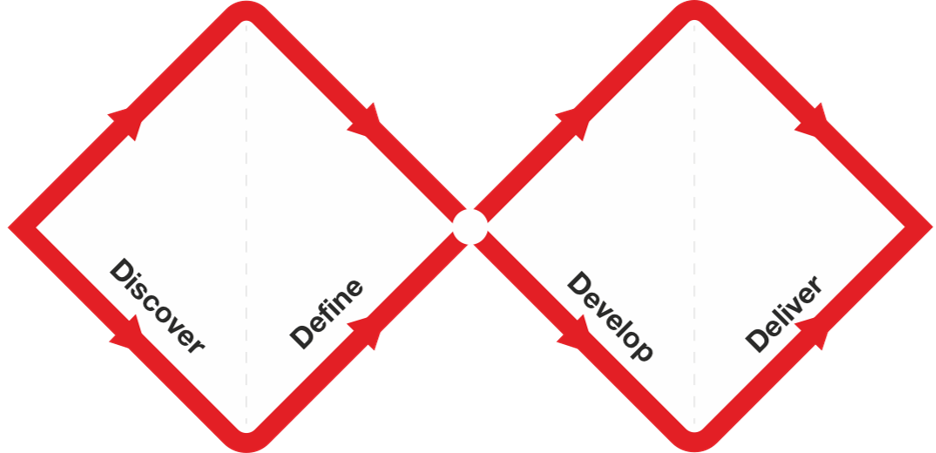
The Design Council’s Double Diamond, a visual model of the divergence and convergence phases. Credit: Design Council, CC BY 4.0, via Wikimedia Commons
The Double Diamond is a visual model proposed by the British Design Council in 2004 and revised in 2019. It represents the design process as two consecutive diamonds, each made up of a divergence phase (you explore broadly) followed by a convergence phase (you synthesize and decide).
First diamond: finding the right problem
- Discover (divergence): You explore the field. You run exploratory interviews, observe users, gather data. The goal is to open up the scope as wide as possible so you don’t miss anything important.
- Define (convergence): You synthesize everything you’ve learned to frame the problem in a clear, actionable way. This is where you build the experience map, identify the priority pain points and craft your “How might we…” statements.
Second diamond: designing the right solution
- Develop (divergence): You generate as many ideas as possible to address the defined problem. This is the ideation phase, where quantity beats quality and the boldest ideas are encouraged.
- Deliver (convergence): You pick the best ideas, turn them into prototypes, test them with users and iterate until you reach a solid solution.
The Double Diamond illustrates a core principle: first find the right problem, then look for the right solution. Too many projects fail because they brilliantly solve a problem nobody has.
The fundamental principles
Every day, useless projects ship. Misreading users, a pale copy of a more effective existing product, a tool built over months that misses the actual need… maybe this has happened to you. Never again.
With Design Thinking, what we’re aiming for is maximum adoption of our idea by users. Two big principles:
- Begin with humans: always start by understanding the current situation in detail from a “human” point of view. Don’t start from a preconceived solution but from a lived problem.
- Design to Think: design in order to think, not the other way around, the way we usually see it with specifications documents. Design is a thinking tool, not just a final deliverable.
These two principles connect directly to the fundamentals of UX: understand before designing.
The 5 stages of Design Thinking
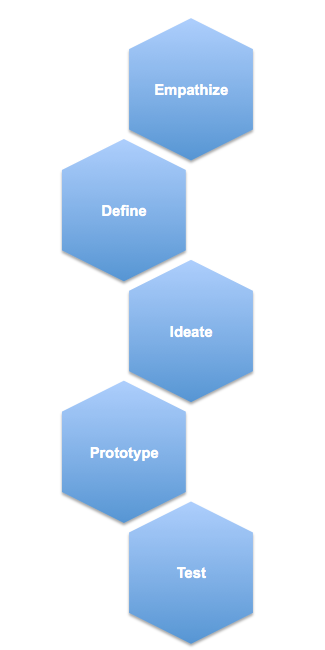
The Design Thinking process per Stanford’s d.school. Credit: Wikimedia Commons, CC BY-SA 4.0
Begin with humans: understand the problem
Too often, we interpret the situations our users live through. We assume our experience is the same for everyone, or we move forward based on assumptions. You have to go into the field to soak up the reality.
Stage 1: Empathize
The goal is to take a research stance toward the users. The most effective way: interview the people involved one by one (between 8 and 20 people) and combine all the feedback with usage data.
The point is to capture the emotions experienced by the panel through a journey the user has taken. To understand what triggered that emotion, and try to understand the underlying need.
Concrete tools:
- Exploratory interviews (45 to 60 min per person, face-to-face when possible)
- Field observation (shadowing) to see what people actually do, not what they say they do
- Large-scale surveys to validate trends quantitatively
- Active listening: an essential skill to run quality interviews
Stage 2: Define
Once the data is collected, synthesizing it is critical to share what’s been learned with a wider group, so you can multiply the angles and the ideas. The experience map is an effective way to synthesize feedback and surface emotions and the user journey.
Concrete tools:
- The experience map to visualize the user’s full journey along with their emotions
- Personas to embody the different user profiles
- “How Might We” (HMW): reframe each identified problem as an open question (“How might we make booking appointments easier for elderly patients?”)
- Jobs to be Done to articulate needs as “jobs to accomplish”
The understanding phase also includes a review of what already exists. Run a benchmark to be aware of solutions already tackling the problem, and understand the angle they chose.
Design to Think: design the solution
Design is the most efficient way to communicate an idea. “A picture is worth a thousand words.” Yet design is barely used in the early phases of projects. We see far too many presentations with fuzzy concepts and an undefined vision.
The goal of this phase is to co-create a tangible concept that can be tested quickly. Let’s break that down word by word:
-
Co-create: Design Thinking relies on multidisciplinarity to avoid groupthink, where every idea looks the same because everyone shares the same job. We favor a mix of profiles (different roles, users joining in…) in ideation workshops. That mix takes the technical and strategic dimensions into account very effectively.
-
Tangible concept: we aim to build something realistic at low cost. For a software project, the goal is to develop nothing yet, just create a prototype based on designed mockups. The concept needs to be something someone can manipulate. See prototyping to go further.
-
Tested quickly: testing is key in Design Thinking. It’s the only way to see whether the concept seems to land with users. One caveat: user tests never validate anything, they reveal trends. If most of your panel is comfortable with a feature, you can infer that the idea seems to work. Based on the feedback, you iterate to improve the concept.
Stage 3: Ideate
Ideation is the phase where you generate as many ideas as possible. The ideation workshop brings together varied profiles (designers, developers, salespeople, users) to explore the space of possibilities.
Concrete tools:
- Structured brainstorming (with clear rules: no judgment, quantity before quality, build on others’ ideas)
- Crazy Eights: sketch 8 ideas in 8 minutes to push creativity
- Collaborative sketching to quickly materialize ideas
- Dot voting to converge on the most promising ideas
Stage 4: Prototype
Prototyping means turning the selected ideas into something you can manipulate. The faster the prototype is to produce, the better. The goal isn’t perfection but learning.
Fidelity levels:
- Low fidelity: paper sketches, simple wireframes, cardboard mockups. Ideal to test a concept in a few hours.
- Medium fidelity: interactive wireframes, clickable mockups. Lets you test a full journey.
- High fidelity: animated visual mockups, functional prototype. For the most polished tests, just before development.
Stage 5: Test
User tests put the prototype in front of real users. You observe, you listen, you take notes. Then you iterate.
Best practices:
- Testing with 5 users is enough to catch 80% of usability issues (Jakob Nielsen)
- Never explain the prototype before the test: watch how the user discovers it on their own
- Ask open questions: “What do you see?”, “What would you do?” rather than “Do you find this nice?”
A concrete example: a meal-delivery startup
To illustrate Design Thinking in action, let’s take a fictional startup that wants to launch a healthy meal-delivery service for offices.
Empathize: the team runs 15 interviews with office workers. They discover that the issue isn’t really access to healthy food (options exist) but the decision time. At lunchtime, people are tired, they don’t want to choose. They end up grabbing a sandwich by default.
Define: the problem is reframed: “How might we remove the mental load of choosing lunch for employees who want to eat healthy?” That problem is very different from “How do we deliver healthy meals to the office?”. The nuance is critical.
Ideate: the team generates 40 ideas in a workshop. Among them: a no-choice subscription (one meal a day, surprise), an order-the-night-before system, an algorithm that learns your tastes. After voting, two ideas are selected for prototyping.
Prototype: in two days, the team builds a paper prototype of the sign-up flow plus a simulation of the “surprise meal” system using a simple Google Form and bike couriers.
Test: 8 employees use the service for a week. Result: the “surprise meal” concept lands, but people want to be able to exclude certain ingredients (allergies, preferences). The team iterates.
Without Design Thinking, this startup would probably have built yet another delivery app with a 200-dish catalog. Thanks to research, they discovered the real problem was decision fatigue, not a lack of options.
When Design Thinking is useful, and when it isn’t
Design Thinking shines when…
- The problem is ill-defined or complex (we don’t really know what to build yet)
- You’re launching a new product or service and need to validate the foundational hypotheses
- You’re working on a topic where humans are central (health, education, public services)
- The team is multidisciplinary and needs a shared frame to collaborate
- You want to break out of the box and avoid replicating what already exists
Design Thinking is less suited when…
- The problem is already well understood and the solution is known (in that case, just execute)
- The context demands a fast decision with no room to iterate (crisis mode, looming deadline)
- Constraints are so heavy there’s no maneuvering room on the solution
- The organization is not ready to question its assumptions (Design Thinking without an open mind is an empty ritual)
The fair criticisms
Design Thinking has its limits too:
- The “innovation theater” risk: some organizations practice Design Thinking superficially, running post-it workshops without ever shipping the results. The process becomes a show rather than a working tool.
- Oversimplification: the 5 stages can give the impression that innovation is a linear, predictable process. In reality, it’s often messy and uncomfortable.
- Missing systemic constraints: Design Thinking focuses on the user, which is its strength, but it can sometimes overlook broader organizational, political or environmental issues.
Despite these critiques, Design Thinking remains an extremely useful framework when applied with rigor and honesty. The point is not to reduce it to a magic recipe but to use it as a thinking tool in service of solving real problems.
Going further
- UX (User eXperience): the fundamentals of the discipline Design Thinking is built on
- The Design Sprint: a condensed 5-day version of Design Thinking, created by Google Ventures
- The ideation workshop: the first concrete step of the design phase
- Exploratory interviews: to run the empathize phase rigorously
- The experience map: a key tool in the define phase
- User testing: to validate your solutions with real users
Sources
- Tim Brown (2008): “Design Thinking”, Harvard Business Review
- Herbert Simon (1969): The Sciences of the Artificial, MIT Press
- Design Council (2004, 2019): The Double Diamond framework
- Stanford d.school: An Introduction to Design Thinking Process Guide
- The Definition of User Experience (UX): https://www.nngroup.com/articles/definition-user-experience/
Want to go further?
I offer individual coaching to dig deeper and apply these topics to your context.
Book a session