Understanding emotions
Introduction
Emotion has been a subject of discussion for thousands of years, from ancient philosophy through today’s neuroscience and the field of psychology. It’s universal, indispensable in any kind of communication, and it’s what allowed vertebrates to survive and evolve.
So why is a topic that’s been so deeply studied and is so important still so poorly understood, especially at work? How do we properly handle emotions in product development or in team facilitation? That’s what we’ll dig into here.
What is an emotion?
An emotion is a physiological and psychological reaction of the body to a situation, which puts it into action. It works a bit like a reflex: we detect emotions even before we’re conscious of them. There are no negative or positive emotions, just bodily reactions to stimuli. Since the reaction is physical, it can usually “be seen” on someone else. Trying to understand someone else’s emotions is part of the attitude we call empathy.
For Paul Ekman, an American psychologist, there are 6 universal emotions: joy, anger, fear, sadness, surprise and disgust. These emotions are recognizable by all humans, even though everyone’s culture will make them react differently to the same stimulus. It’s generally accepted that these 6 emotions are considered the so-called basic emotions.
Focus on the body’s physiological reactions to emotions, in video
The educational French TV show C’est pas Sorcier tackled the topic of emotions effectively. Their summary helps you understand how emotions are created in the brain and the effects they have on it.
Focus on the difference between emotion and feeling
An emotion is a reaction of the body that lasts a few seconds, since it comes from the fast-response nervous system. The emotion sends us a message to push us into action. We say that an emotion “is lived”: I can live my anger, or I can be angry without showing it physically. In the second case, we’d talk about a feeling.
The feeling has 3 distinct characteristics compared to emotion:
- it doesn’t express itself physiologically: it’s mentalized (and so it’s unlikely to show up physically). It’s built in the neocortex, the seat of reflection and analysis.
- it’s less intense: the feeling doesn’t push us to act. It invites us to think about the best thing to do to stop feeling bad. If no action follows, it can settle deeply within us.
- it lasts longer: to have a feeling, you need to step back, reflect on what happened and assess how you behaved. It can last for hours, days, months, years…
So we can say that emotion alerts and feeling analyzes.
For the rest of this lesson, when I say “emotion” I’m focusing on the previous definition of emotions. When I say “felt experience”, that includes both emotion and feeling.
The emotional awareness ladder
Claude Steiner, a Franco-American psychologist, introduced over the course of his research the notion of an emotional awareness ladder. He introduced a concept of levels describing our ability to use emotions. He introduced 7 levels, which I’ve simplified by keeping the 4 main ones.
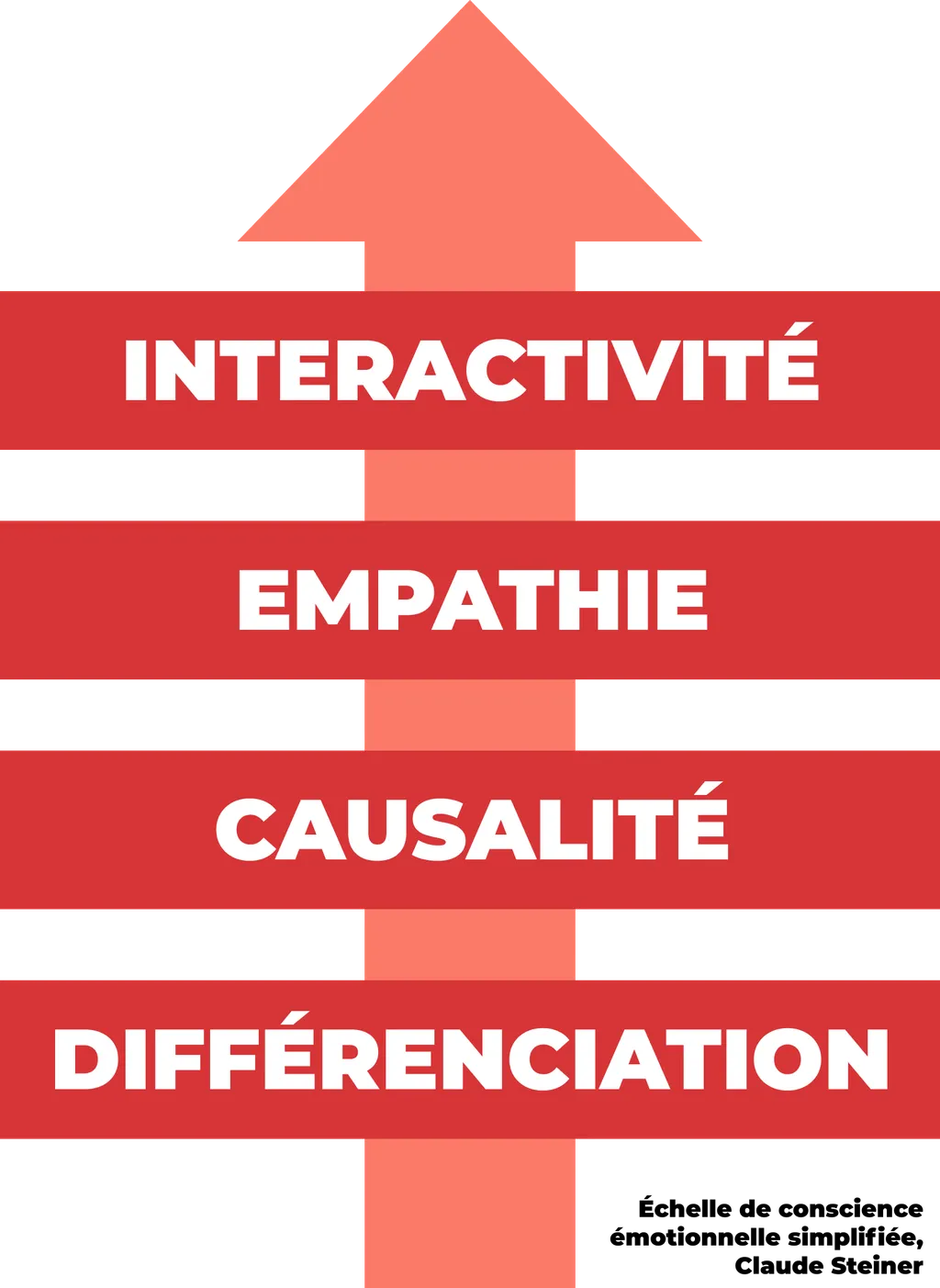
First level: differentiation
People at this level can recognize the different emotions and their intensity. They can clearly tell joy from anger and fear from sadness, for example. They can also verbalize these emotions: this is called crossing the verbal barrier.
What’s more, being able to express your emotions (so by using “I”) makes you unassailable in discussions or debates. Expressing your emotions is expressing your truth.
Second level: causality
People at this level can identify the causes that triggered their emotions. These causes include the stimulus that triggered the emotion as well as the underlying need (which is therefore what triggered the emotion). These people understand why they feel what they feel.
Third level: empathy
People at this level can question other people’s emotions in order to become aware of those emotions. Because the cause and the other person’s emotion are clearly identified, I can then put myself in their shoes.
Fourth level: interactivity
Finally, people at this level have a very good knowledge of their own emotions and others’ emotions, which lets them anticipate how others will react. This can help defuse conflicts while not being part of the equation themselves.
Emotion: message and need
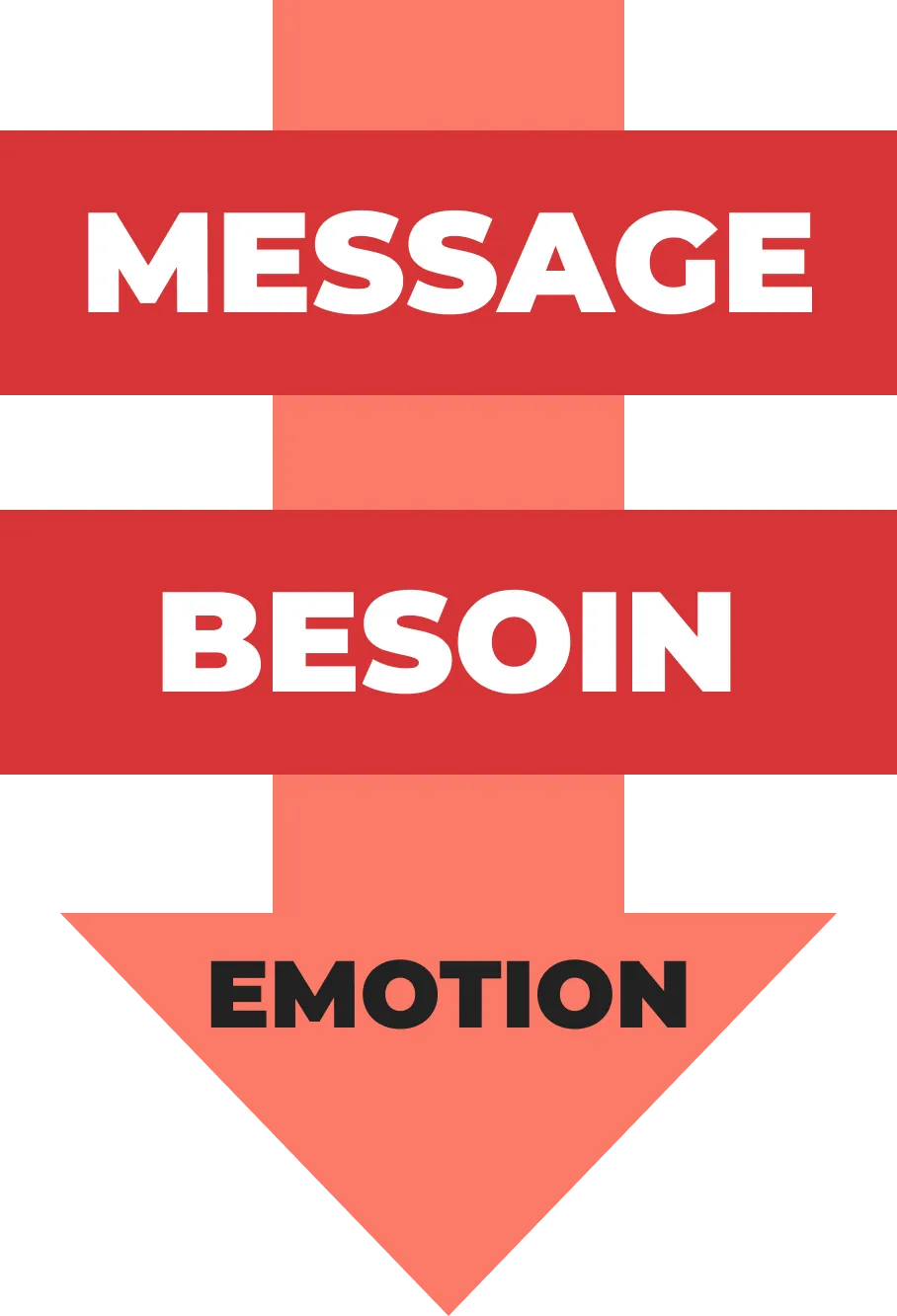
We can summarize emotions like this: each emotion carries a message. From it flows one or several needs. Your job is to understand what messages the different emotions you’re picking up on are conveying.
You’ll find below the basic emotions model that goes deeper on describing the messages and needs across the different categories of emotions.
What is a need in NVC
According to Marshall Rosenberg, an American psychologist and the father of Nonviolent Communication, behind emotions there are needs. He defines them like this:
- they’re universal (shared by every human being);
- they’re independent of any context, in particular they aren’t tied to:
- a specific person
- an object
- an action
- a particular situation
- there’s an infinite number of ways to meet them. Rosenberg calls “strategies” the actions we take to meet them.
In Nonviolent Communication, the phrase “nonviolent” is a reference to Gandhi’s movement and means communicating with the other person without doing them harm. Also, a need is never something you can do, nor something you can take or touch. It’s a more general kind of need, as shown in the list below. But you can identify whether your needs are met by a physical sensation.
Exercise: express an emotion and a need
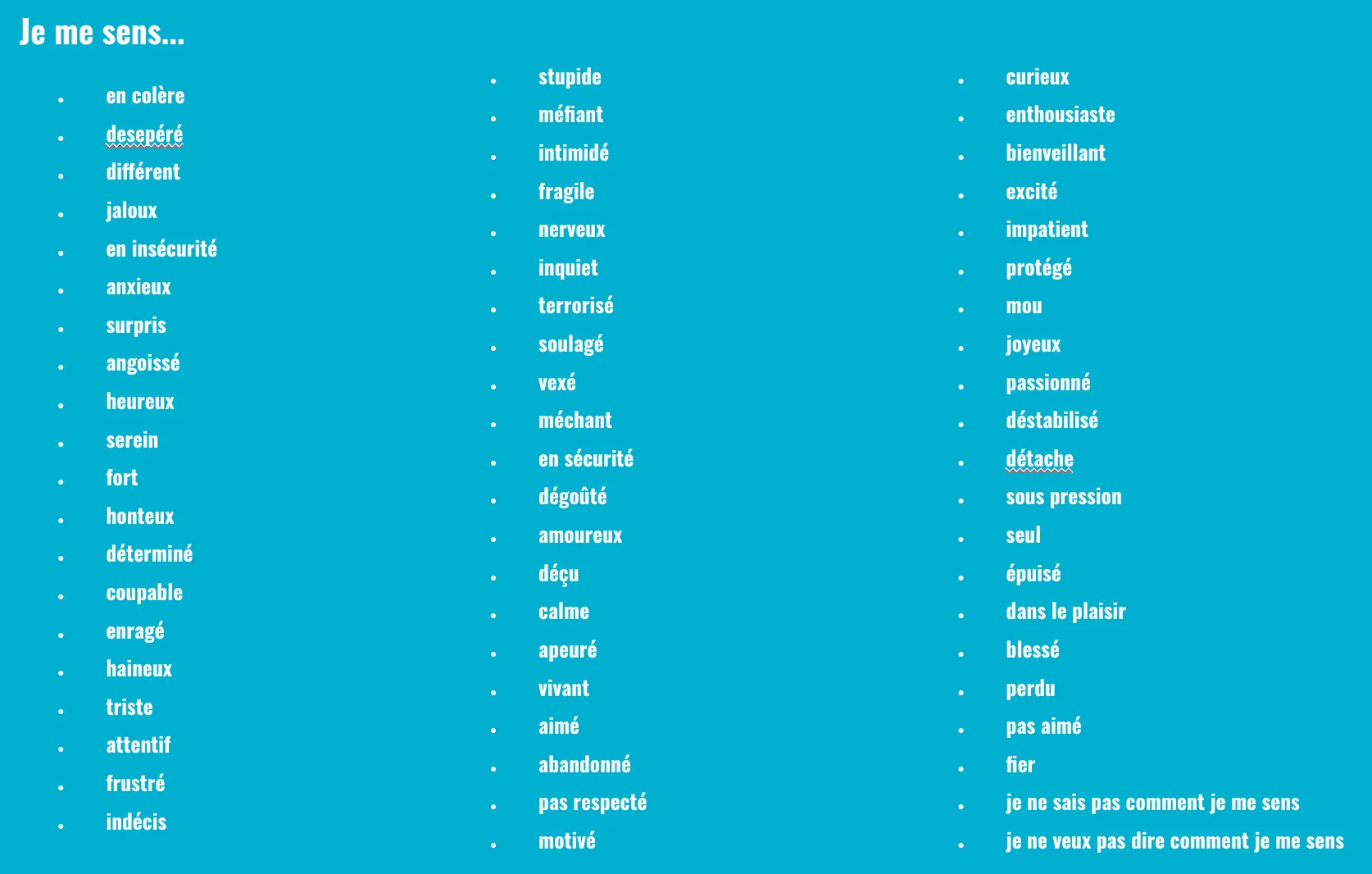
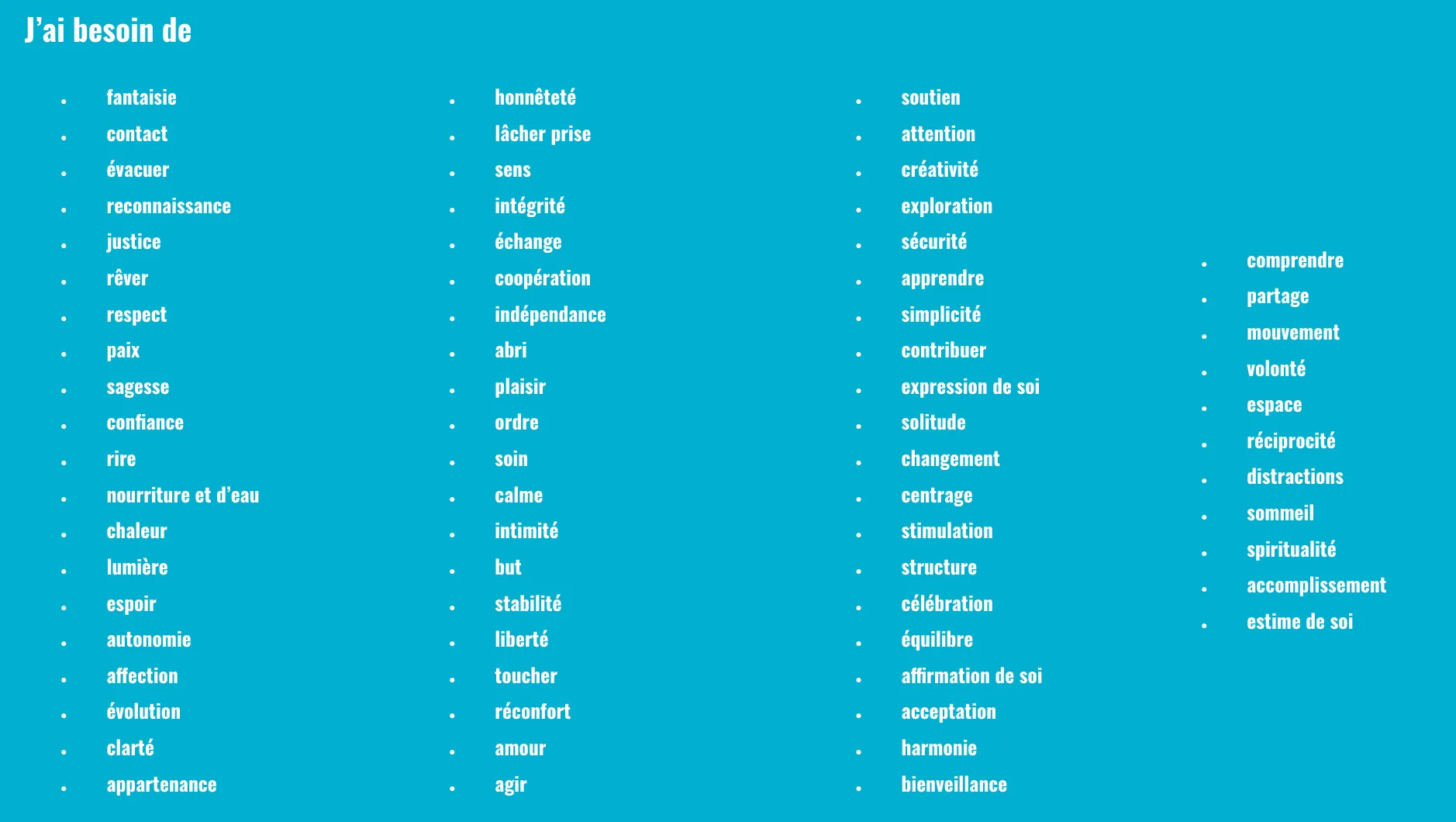
To get a feel for this model, here’s a list of feelings and needs from Nonviolent Communication. With these 2 lists, you can practice using the following method:
- Recall a moment when you experienced a strong emotion.
- Pick from the following list the felt experience that fits that memory best.
- Then identify the needs you had behind that felt experience.
- Ask yourself whether those needs were met, and if so, whether they were met in a way that was satisfying for you.
- (and if not) Identify a strategy to meet them in a satisfying way.
The basic emotions model
Paul Ekman is one of the first psychologists who managed to demonstrate that there were so-called basic emotions. They are joy, anger, fear, sadness, surprise and disgust.
To test this, he went to meet peoples in Papua New Guinea who had no prior contact with other populations around the world. He showed them a set of photos of faces expressing emotions. He concluded that 6 emotions were universally recognized by humans, even without being shaped by culture.
There are other models of this kind that include more or fewer emotions, like Plutchik’s (8 basic emotions). Each model captures a slice of reality and is neither completely wrong nor completely right. For my part, I use a model that’s simple to understand and remember, especially during my active listening sessions with users.
The simplified basic emotions model
Even though Paul Ekman identified 6 so-called basic emotions, I prefer to use a simplified model by dropping disgust and surprise. Surprise is a “transition” emotion, meaning it gives way to another emotion right after. And I rarely run into disgust in my day-to-day, so I prefer to remove it for the sake of simplicity.
So, as explained earlier, I use a model that introduces the notion of message and need for each category of emotion. The need behind each emotion isn’t unique, there can obviously be others. But from experience, I’ve found that the need listed in the model below covers most cases: I love how simple this model is because I can remember it very easily.
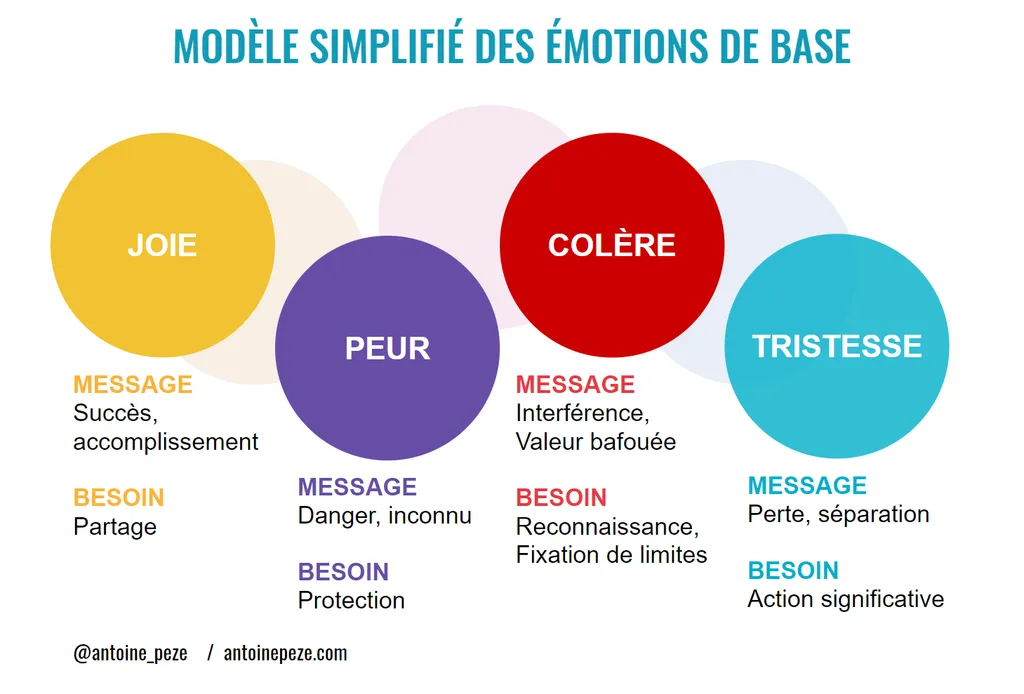
I’d encourage you to remember this model, it’s handy to find your bearings in everyday life and to understand others’ reactions. But understanding them isn’t enough: you can take it further by interpreting them for the other person to help them put their finger on it, which leads to one-of-a-kind conversations!
Reacting to emotions
Just name the emotion you spot in the other person, it’s very simple and yet very hard because it’s deeply unfamiliar. By doing this, you invite the other person to say more while staying caring. And don’t worry, people are perfectly comfortable “correcting” their emotion if you’ve interpreted the wrong one!
So here are:
- the full cycle to deeply understand an emotion in someone else
- a guide of questions and phrases to interpret the other person’s emotion while keeping a climate of trust (because nobody likes being analyzed without asking for it)
- a guide of questions to find the dominant underlying need
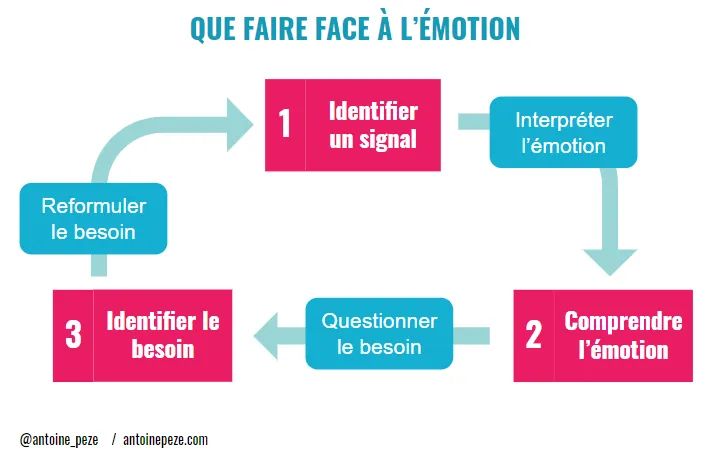
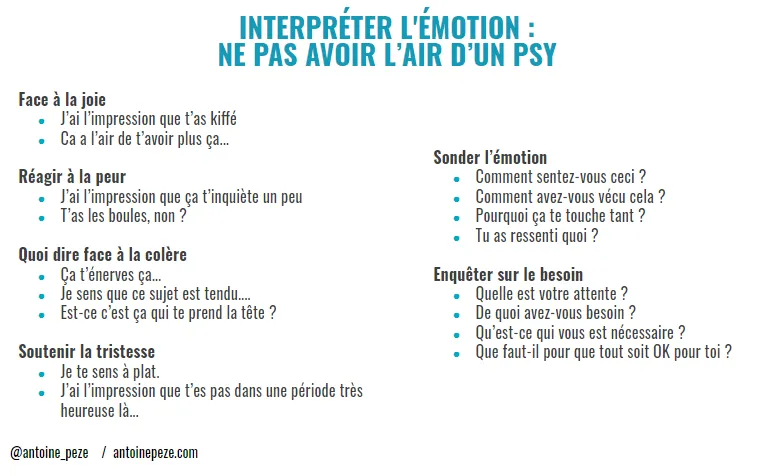
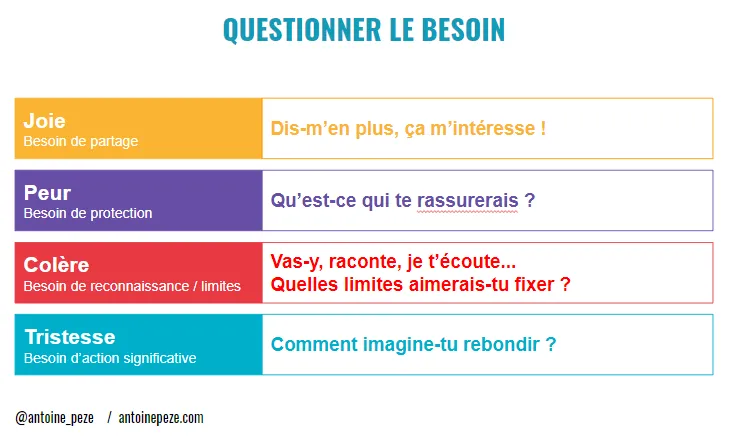
These questions are particularly useful during interviews with users in product discovery phases. Whether for exploratory interviews, user tests or other techniques based on active listening, I always keep these markers in mind, which lets me go especially deep on the emotional dimension. As a result, I’m able to gain a fine-grained understanding of the pain points by interpreting as little as possible the underlying needs, since I bring up the topic with them directly.
The two-dimensional model
James A. Russell, an American psychologist, developed the Circumplex. It’s a two-dimensional model used to place emotions on a 2D axis: valence and activation (or arousal).
- Valence distinguishes positive, pleasant emotions like joy from negative, unpleasant emotions like anger.
- Activation represents the level of bodily excitement, which shows up through a number of physiological reactions like an accelerated heart rate or sweating.
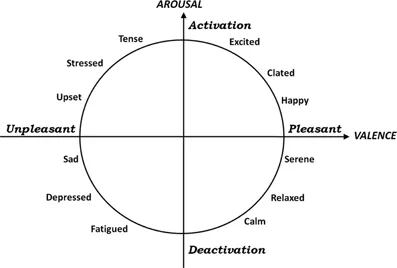
This model has been very successful because it can represent an infinite number of emotions, and it makes it easy to represent nuanced emotions. The downside is that it doesn’t propose rules for processing and analyzing emotions.
A simplified model: negative and positive emotions
Even though an emotion isn’t inherently positive or negative, it can be considered pleasant or unpleasant after asking people about those emotions. So by keeping only the “valence” axis, we get a model that’s particularly easy to grasp.
That’s the model I use to build my experience maps. The advantage of this way of representing emotions is that it lets you:
- compare them with each other
- immediately spot the peaks (the famous pain and satisfaction points)
- have a simple representation of emotions, but less precise than by category
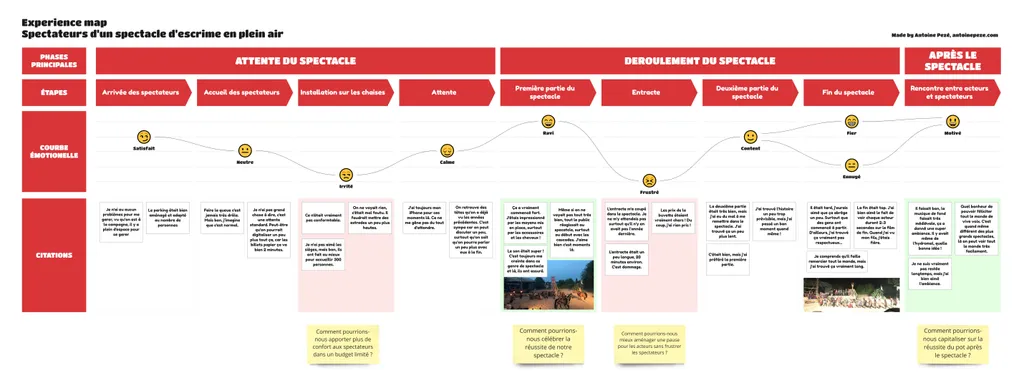
An example of using the simplified emotional valence model. Learn more about this experience map here!
Conclusion
We’re confronted with emotions every day. And yet we’ve never been taught how to handle them, to the point where they’ve become taboo in most professional contexts. It doesn’t have to be that way, and techniques like active listening let you build on these emotions to have better relationships around you.
The simplified basic emotions model lets you easily identify your own emotions and the associated needs. It’s also a guide for probing other people’s felt experiences. This model is particularly effective in understanding or facilitation activities.
The simplified positive/negative emotions model offers something that’s very simple and quickly understandable by anyone. This model is particularly effective in synthesis activities like the experience map.
Lastly, to make progress on the topic of emotions, there’s no magic bullet, you just have to practice. So here are 2 exercises you can start with to make progress on this topic:
- Rather than criticizing a situation, the next time, try starting by expressing your emotion with a sentence that begins with “I” rather than “You”.
- If you spot an emotion during a conversation, try naming it for the other person with a sentence like “I get the sense that this… (really pleases you, worries you, saddens you, frustrates you)”. You might be surprised by the result!
Going further
- Understand active listening
- How to give good feedback
- How to run a retrospective
- Buy the workshop cards describing emotions: “Le langage des émotions” (in French)
- Buy the workshop cards describing needs: “L’expression des besoins” (in French)
- Étude de la documentation sur l’intelligence émotionnelle et ses conséquences en milieu correctionnel, Yvonne Stys and Shelley L. Brown (2004): https://www.csc-scc.gc.ca/recherche/092/005008-0150-fra.pdf (in French)
- Illustration of the concept of emotional literacy through excerpts from Isabelle Filliozat: https://xn—matransformationintrieure-tic.fr/alphabetisation-emotionnelle/ (in French)
Sources
- Emotional Literacy; Intelligence With a Heart, by Claude Steiner (2003), Personhood Press: https://livre.fnac.com/a9879755/Inconnus-Emotional-literacy
- Atlas of emotions, Paul Ekman (2020): http://atlasofemotions.org/
- Research site on Russell’s Circumplex (2020): http://emotiondevelopmentlab.weebly.com/circumplex-model-of-affect.html
Want to go further?
I offer individual coaching to dig deeper and apply these topics to your context.
Book a session