How to run a vision / mission workshop
What is a vision / mission workshop?
A vision / mission workshop is a half-day session (about 3 hours), held very early in a project, to write the vision (the desired future, in one sentence) and the mission (the purpose, in one sentence) with all the stakeholders.
The goal is to dig into the “why” and the “how” so that everyone clarifies what they want and the whole team is fully aligned.
Context for the vision / mission workshop
Program (3h)
The workshop is structured around 3 axes: past, present, future. We start with the past (the history), continue with the present (what we do, the mission), then project forward (vision and risks).
- 15 min: Round of introductions, kickoff, expectations
- 30 min: History
- 15 min: Vision / mission walkthrough
- 15 min: Break
- 45 min: Building the mission
- 45 min: Building the vision
- 30 min: Risk workshop
Group composition
The ideal group is made up of:
- a project or product lead (the decision-maker)
- the team members
- a facilitator
History (30 min)
Goal: understand why we are where we are today.
The facilitator builds a timeline showing all past events. They ask the group to recall every meaningful event tied to the product or service in question (1 event = 1 sticky note). For each event, they ask for a date (month + year, on a separate sticky note). The timeline is built with dates on top and events stacked below.
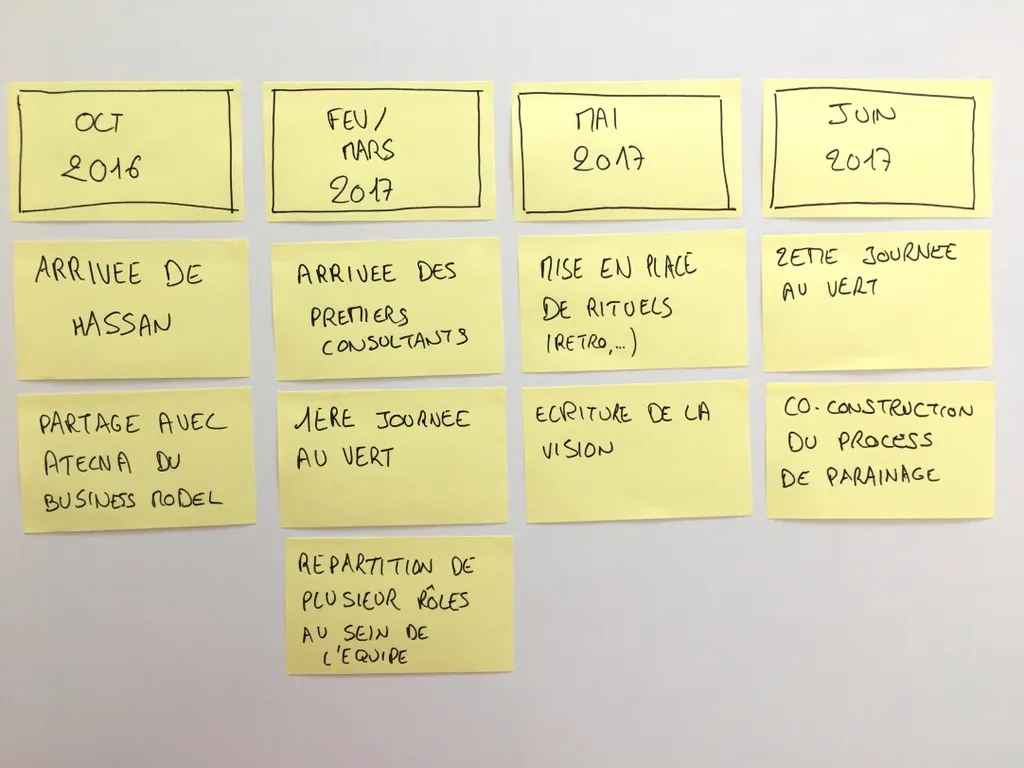
Example of a history timeline
Walking through vision and mission (15 min)
Definition of vision 🔭
A one-sentence statement that describes a future, desirable state of the organization and/or its environment that we strive toward. Think of it as a utopia, a north star. It sets a challenge, gives direction, and lets you derive a strategy from it.
Here’s an example of a vision statement:
“Create the most compelling car company of the 21st century by driving the world’s transition to electric vehicles.”
For a company, the goal is to inspire and motivate teams by giving the project meaning. The vision also makes it easier to write strategy and make decisions, since it acts as a filter: does this decision move us toward this vision?
Definition of mission 🎯
A one-sentence statement that describes why your organization or program exists. Think of it as a purpose, a simple explanation of what you do.
Here’s an example of a mission statement:
“Organize the world’s information and make it universally accessible and useful.”
For a company, this aligns team members around a shared goal, which fuels motivation. For people outside the team or company, it makes very clear what you do and gives everyone a shared way of talking about it.
3 writing rules for mission and vision
Easy to understand
- Plain language: vocabulary a middle-schooler would get
- Find precise adjectives
- Avoid the buzzword trap
Short and to the point
- 15 words max
- Easy to memorize and recite
- Inspiring, motivating, and distinctive
To inform, unify, guide
- Not too broad and vague, not too narrow and limiting
- Refine until it becomes crystal clear
- Whatever the phrasing, the statement must inform, unify, and guide
A few examples of missions and visions
Example 1: vision and mission from my own site
Antoine Pezé - vision (the utopia, the north star)
Every facilitator is proud of the workshops they have run.
Antoine Pezé - mission (the what, very concrete)
Contribute to teams’ success by sharing for free how to listen well and run meaningful workshops.
Example 2: brands with clear visions and missions
eBay - vision
Be the world’s best destination for discovering great value and unique selection.
eBay - mission
Provide a global trading platform where practically anyone can trade practically anything.
Oxfam - Vision
A just world without poverty.
Oxfam - Mission
Create lasting solutions to poverty, hunger, and social injustice.
Example 3: a list of visions and missions in English
- Visions and missions of major American companies: Vision and Mission Statements Archives - Panmore Institute
- Mission examples for nonprofits: 50 Example Mission Statements
- Vision examples for nonprofits: 30 Example Vision Statements
Building your vision (45 min)
1. Big questions
- Get the group talking around big questions for about 10 minutes:
- “What would let us say our project has actually changed things?”
- “If we project ourselves 2 years out and the project is working, what has changed around you?” In parallel, the facilitator takes notes on sticky notes around the key ideas. The idea is to reignite the discussion when it dries up. Bounce off ideas that emerge and ask the other big questions. The aim: be inspiring and aim for utopia.
2. Organize the ideas and reframe
- Post the collected sticky notes on the wall, then add or modify some based on the team discussion.
3. Double vote
- The whole team except the decision-maker votes for the sentences they prefer (unlimited votes, 1 vote max per sticky note).
- Then the decision-maker votes for the sentence they prefer. They will be influenced by the previous votes.
4. Recap
- The facilitator collects everything and proposes a sentence at the end of the workshop, to be validated by the decision-maker.
For reference, I draw on the 4-4-4 concept to keep timing in mind:
- a vision at 4 years
- a roadmap at 4 months
- a backlog at 4 weeks
Building your mission (45 min)
1. Writing sticky notes around 3 main categories
Instructions: “You have 3 minutes to write your ideas across the 3 categories below. Each sticky-note color matches a category.”
- Beneficiaries: which distinct groups of people are involved?
- Service / Problem: what do we offer that is unique or very specific to us? / What problem are we trying to solve?
2. Sorting groups and reducing
- Beneficiaries: sort and group to keep at most 2 roles
- Services and problems: shorten the service description by removing as many commas and “ands” as possible.
3. Precision
- Synthesize one or several sentences that describe the mission (remember, 15 words max, simple vocabulary).
- Add adjectives that describe the different terms more precisely and check whether they’re necessary.
- Are you comfortable with the sentence that emerges?
- As long as you have thumbs down, take their suggestions on board and re-vote.
Risk workshop (30 min)
1. Surface the risks
- Ask the question: “We’re 1 year out and the project is going badly. Who is upset with you, and why?”
- Ask everyone to write on 2 different sticky notes the people involved and their reasons (3 minutes of sticky-note writing).
- Ask each person to come stick their notes up.
2. Vote
- Ask each team member to vote on the risks that seem most important to them (3 votes per person).
3. First actions
- Take the sticky notes that received votes and stick them vertically on the wall, ordered by number of votes.
- Ask the group: “What action can we take to manage this risk?”
- Write the action on a sticky note (always start with a verb in the infinitive).
- Pair it with an owner: a single, clearly identified person who accepts the task.
What to do after a vision / mission workshop?
From what I’ve seen, it’s hard to land a fully usable result by the end of this workshop. So I’d suggest continuing the work a bit afterward to rewrite a clean vision and mission and validate them with the sponsor.
Concretely, after this kind of workshop, I do my best to draft vision and mission sentences based on every conversation I listened to. Once that’s done, I share them with the sponsor, whose job it is to validate and broadcast them. I recommend the sponsor “sleep on it” and send me their feedback so I can adjust and we land on a final version.
Don’t forget, the goal is simplicity in these sentences, that’s the biggest challenge. And very often, the sponsor will want to add a lot to them! Stay vigilant ;)
Going further
- Exploratory interviews to understand the vision from the field
- The experience map to synthesize user feedback
- The ideation workshop to surface innovative and relevant ideas based on your vision and mission
- OKRs to define measurable objectives based on your vision
More info
PDF from topnonprofits explaining how to build a mission:
MissionStatementCheatSheetsWorksheetsv2.2 DownloadWant to go further?
I offer individual coaching to dig deeper and apply these topics to your context.
Book a session