How to facilitate an OKR workshop
What is an OKR?
OKRs are objectives and indicators co-built by the team and renewed every 3 months. The acronym OKR stands for “Objective and Key Result”.
OKRs aim to align a team to collectively reach objectives. So the goal of this approach is to build your strategy as a team.
Introduction to OKRs
We now have studies (see sources at the end of the page) showing that setting objectives improves employee performance. More specifically, setting precise and ambitious objectives helps you reach them.
The OKR technique is a fitting answer to the results of these studies: the point is to set explicit objectives to move your organization forward.
The growing popularity of OKRs is mainly attributed to Intel (1983) and Google (since 1999), which adopted this technique for their planning. Since then, organizations like LinkedIn, Twitter and Uber have adopted them across their entire company.
OKRs in detail
The OKR technique, for “Objectives and Key Results”, consists of writing 3 objectives accompanied by key indicators. Each objective is therefore composed of:
- A sentence describing the Objective (“O”):
- with no figure
- describing the direction to take
3 to 5 key results (“KR”) to reach (ideally 3):
- composed of a sentence describing the key result:
- mandatorily including a measurable indicator related to the objective
- mandatorily including a target value to reach
- which must be ambitious, above what’s “achievable”
and a measure of success for this key result
- between 0 and 1
- describing the success of the objective (0 if no progress, 1 if the objective is fully reached)
A global measure, tied to the Objective:
- between 0 and 1
- being the average of all key result measures for the objective in question
The point of OKRs isn’t to fully reach all objectives but to position the organization on ambitious objectives, above what’s achievable. You should aim for an objective measure around a score of 0.7.
Below 0.6, either the objectives were truly too ambitious, or the organization underperformed.
Above 0.8, either the objectives weren’t ambitious enough, or the organization overperformed.
OKRs at two levels
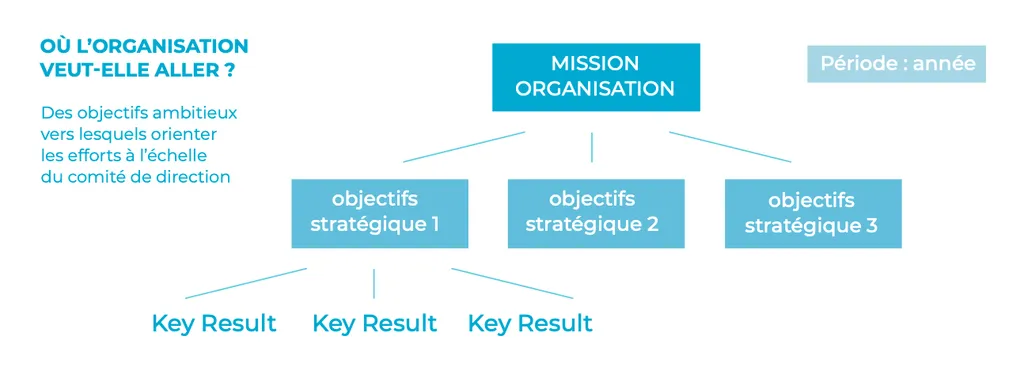
A classic way to do OKRs is to write them at 2 organization levels.
- Strategic OKRs
- scale: 1 year
- contributors: leadership team
- decision-maker: CEO
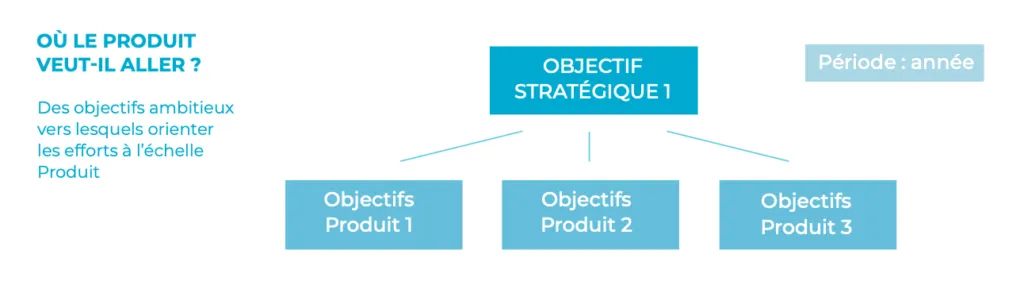
- Team OKRs (or tied to the product or part of the product)
- scale: 3 months
- contributors: all members of a team
- decision-maker: team lead
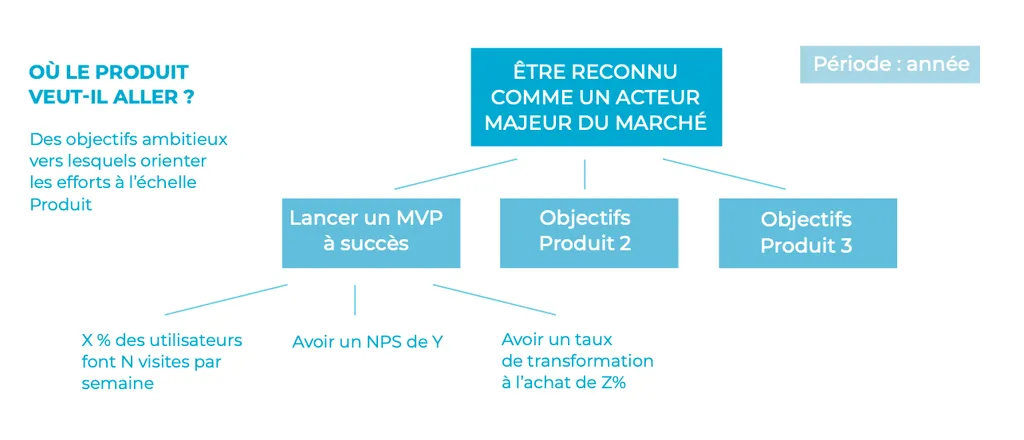
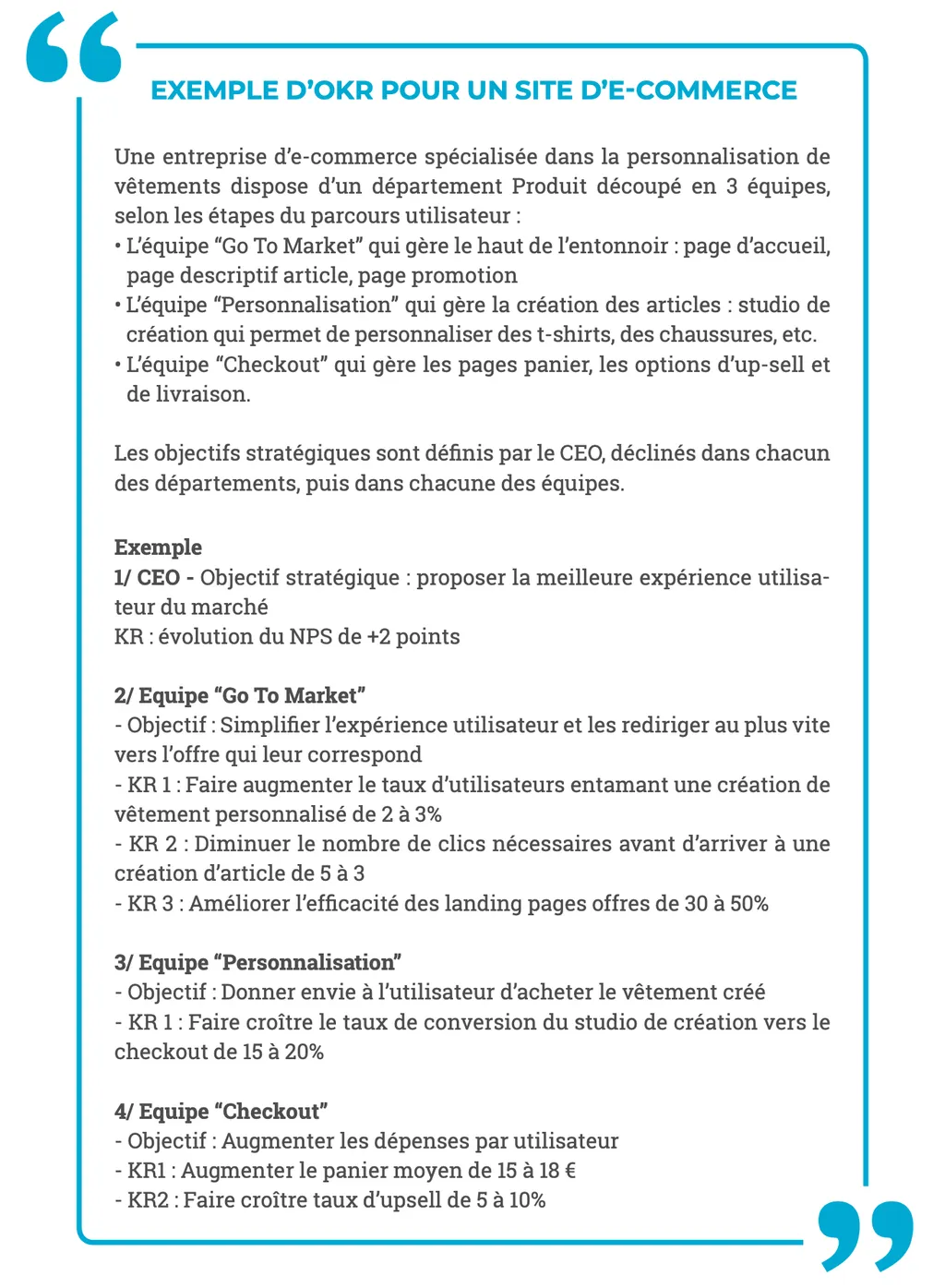
OKR examples
All blue-background images come from the Thiga book, Les organisations orientées Produit - Chapter 2, How to steer Product objectives? (source at the end of the page)
 [re:Work] OKRs (Objectives and Key Results) Scorecard
Example from the re:work site
Objective: Improve [product]‘s reputation
Key Results:
- Re-establish [product]‘s leadership by speaking at three industry events
- Identify and personally reach out to top 10 users
- Shorten response time to user-flagged errors by 15%
Context for an OKR workshop
Quarterly team OKR workshop agenda (2h)
- (10 min): Explanation of the OKR concept
- 15 min: Strategic OKRs - Display & Explanations or Recap & Review
- 45 min: Defining Objectives
- 45 min: Defining Key Results
- 5-15 min: Action-taking and debrief
Group composition
- team lead
- team members
- facilitator
Explaining the OKR concept (10 min, if needed)
If some people don’t know about OKRs, the facilitator recaps the stakes and usefulness of OKRs.
See the OKR explanation section above
Strategic OKRs (15 min)
The facilitator presents, or asks the lead to present, the strategic objectives the team needs to align with. The point is to present them and explain the choice of associated Key Results. It’s important to present the company vision these strategic objectives are built upon.
So you’ll see that an OKR workshop needs preparation. It’s important to plan a session to define strategic OKRs before defining quarterly ones. At the very least, set your annual objectives before starting this workshop, no matter how you derive them.
Defining Objectives (45 min)
The facilitator gives all team members the following instructions:
“Write on sticky notes the objectives that seem important to address, given the strategic OKRs.
- No figures expected. We’re looking for action verbs, like “improve”, “increase”, “reduce”, etc.
- Each sentence starts with an infinitive verb
- Avoid objectives that don’t propose any accomplishment, like “maintain our margin” or “continue recruiting”
- 1 sticky per objective
- You have 5 minutes to write as many stickies as you want”
After the 5 minutes, each person comes up to present their stickies, one after the other, and stick them on the wall.
After the explanations, the facilitator groups the stickies and assigns a title. This title should be in “Objective” format (infinitive verb, no figures but 1 direction) and they will rally the group to reformulate them.
After this grouping, the facilitator will ask all members EXCEPT THE DECISION-MAKER the following:
“You now have 3 votes each to determine the 3 most relevant objectives to address this quarter. Once your votes are done, the lead will determine the objectives, influenced by your votes. I’ll let you vote.”
After the votes, the facilitator asks the decision-maker to make the final choice of the 3 objectives for the quarter. 2 tricks to highlight their vote:
- give them a thicker marker
- frame the selected stickies
Defining Key Results (45 min)
The facilitator asks the group to split into 3 groups (= the number of objectives), based on their interest in the objective. They give all team members the following instructions:
“Write on sticky notes the Key Results tied to the objective you’re handling.
- Each sentence starts with a verb and contains a concrete way to measure and a target value to reach
- Don’t be afraid to be ambitious. Your target values should be a bit above what’s “achievable”
- You need to identify impacts, not activities. For example, don’t write “ship the new feature” but “15% of our users have used the new feature”
1 sticky per Key Result
You have 5 minutes to write as many stickies as you want”
Over the next 20 minutes, each person presents their results to their sub-group. After this presentation, each sub-group must select the Key Results that seem most relevant to them. A selection is then made (reformulation, adding ideas, etc.)
After this phase, each sub-group presents all its Key Results (plan 10 min for this phase). A discussion can follow.
Finally, each person EXCEPT THE DECISION-MAKER is invited to vote for the 3 Key Results that seem most relevant to them, per Objective (9 votes total). Then the decision-maker selects the Key Results for the quarter.
Action-taking and debrief (5-15 min)
If there’s time left, the facilitator runs a brainstorming session to identify the actions needed to reach the Key Results.
Each action will be:
- described by a sentence starting with an infinitive verb
- assigned a single owner, responsible for moving the action forward
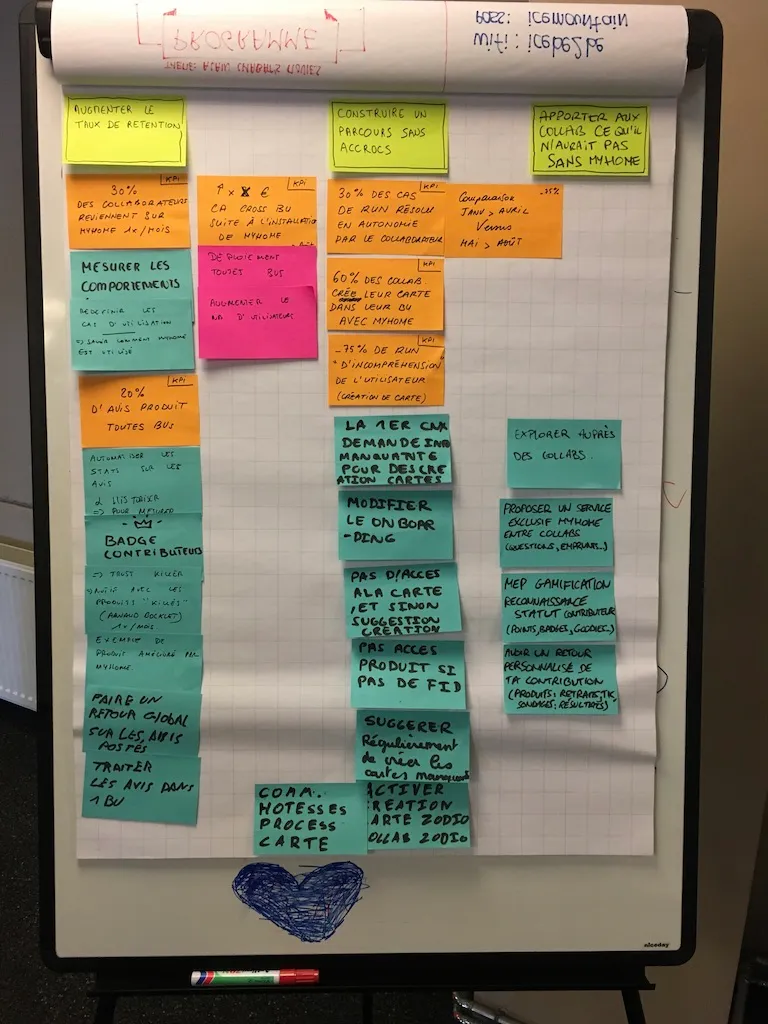
Result example: in yellow the Objectives, in orange the Key Results, in blue/pink the actions
The facilitator finally proposes a debrief by re-reading all Objectives and their associated Key Results.
Post-workshop actions
The facilitator (or the person in charge of this action) will produce a document synthesizing the workshop results. Google offers the following template:
[re:Work] OKRs (Objectives and Key Results) ScorecardAny other document can be produced in this spirit. The point is to make information transparent by making it easily accessible to all.
If no actions were taken, due to lack of time, you must run a workshop on action-taking for the upcoming quarter.
Each month, you need to:
- track OKR progress and share it with the whole team
- check in on action progress
After 3 months, you need to:
- review the OKRs of the past quarter
- share the results
- run a new OKR workshop
Going further
- The Mission / Vision workshop: to define direction before the OKRs
- The retrospective: to review the OKR quarter
- The Story Map workshop: to break objectives into actions
Sources
- How leaders stimulate employee learning: A leader–member exchange approach: https://onlinelibrary.wiley.com/doi/full/10.1348/096317909X468099
- Building a practically useful theory of goal setting and task motivation - A 35-year odyssey: https://www.researchgate.net/publication/11152729_Building_a_practically_useful_theory_of_goal_setting_and_task_motivation_-_A_35-year_odyssey
- re:work - Set Goals With OKR: https://rework.withgoogle.com/guides/set-goals-with-okrs/steps/introduction/
- Learn more about OKRs, evolution4all white paper (in French): https://drive.google.com/file/d/1cejfm0gEHT0I_hSjYXZzvTHQ2DHe2sGT/view
- Thiga book - Les organisations orientées Produit - Chapter 2, How to steer Product objectives? (in French): https://thiga.co/product-academy-vol-3/
Want to go further?
I offer individual coaching to dig deeper and apply these topics to your context.
Book a session