How to use the Jobs-to-be-Done framework
TL;DR
Summary
The Jobs-to-be-Done framework (JTBD) is an approach that focuses on understanding why people “hire” a product or service to accomplish a specific task in their life. Rather than focusing on who the user is, you focus on what they’re trying to get done.
Goals
Identify the deeper motivations of your users, formulate their “jobs” in a structured way, and prioritize innovation opportunities based on the jobs that are the most poorly served.
What is Jobs-to-be-Done?
Jobs-to-be-Done is a framework that posits that people don’t buy products — they “hire” them to get a job done in their life.
This idea was popularized by Clayton Christensen, professor at Harvard Business School and author of The Innovator’s Dilemma. Christensen developed the theory from a simple observation: traditional marketing tools (demographic segmentation, personas based on age or income) don’t predict why a user picks one product over another.
The milkshake story
The founding story of JTBD is the McDonald’s milkshake. A fast-food chain wanted to sell more milkshakes. The marketing team had segmented customers by demographic profile, run focus groups, and tweaked the recipe. No meaningful improvement.
Clayton Christensen and his team took a different approach. They posted up in a restaurant and observed. They discovered that 40% of milkshakes were bought before 8:30 a.m. by people on their own, who left right away in their car.
By interviewing those customers, they understood the “job”: these people had a long morning car commute. They needed something that would fill the trip, that could be consumed one-handed, that lasted a long time, and that held them over until lunch. The milkshake was being “hired” for the job of “making my morning commute less boring and keeping me full.”
The milkshake’s competitor wasn’t another milkshake. It was the banana, the bagel, the donut, boredom itself. This insight completely changed the team’s approach: they made the milkshake thicker (so it lasted longer), added pieces of fruit (to create surprise), and simplified the buying process (so morning customers could order and leave quickly).
The shift in perspective
JTBD performs a fundamental shift in perspective:
- Traditional approach: “Who are our users?” then “How do we sell our product to them?”
- JTBD approach: “What job are our users trying to accomplish?” then “How can our product accomplish that job better?”
This shift in perspective is useful because it frees you from fixating on the existing product. When you think in terms of jobs, you realize your competitors aren’t necessarily who you think. An Excel spreadsheet might compete with a project management tool, a paper notebook, or even a whiteboard, if the job is “organize my tasks for the week.”
The JTBD formula
The structured formulation of a job is essential to make the framework actionable. Several formats exist, but the most common and most practical is the following:
When [situation / context], I want to [motivation / action], so that [expected outcome / benefit]
The three components
1. The situation (When): the triggering context. It’s the moment or circumstance that gives rise to the need. The more precise the situation, the more actionable the job.
Examples:
- “When I’m on my commute in the morning…”
- “When I get an email from my manager asking for a status update…”
- “When I have 15 minutes between two meetings…”
2. The motivation (I want to): what the person is trying to do. It’s the action or change they want to bring about. Watch out: this isn’t the desired feature, it’s the intent.
Examples:
- ”…I want to stay informed about news in my industry…”
- ”…I want to put together a summary table of our key metrics…”
- ”…I want to relax without committing to something long…”
3. The outcome (So that): the deeper benefit being sought. It’s the “why behind the why.” This outcome is often emotional or social, even when the job seems purely functional.
Examples:
- “…so that I look informed in meetings with my peers.”
- “…so that I reassure my manager about the project’s progress.”
- “…so that I feel rested for the next meeting.”
Full examples of formulated jobs
- When I’m on the subway in the morning, I want to read short articles about my industry, so that I start my day feeling informed and prepared.
- When I’m hosting a dinner at home for friends, I want to find a recipe that’s impressive but simple, so that I get compliments and have a great time without stressing in the kitchen.
- When I start a new project at work, I want to quickly understand the stakes and stakeholders, so that I avoid making political mistakes and earn the team’s trust.
The three dimensions of a job
A job is never purely functional. Every job has three dimensions you should explore to truly understand the user’s motivations.
The functional job
This is the practical task the user wants to accomplish. It’s the most visible and most easily identified dimension.
Examples:
- “Send a document to a coworker.”
- “Find a restaurant that’s open nearby.”
- “Calculate the amount of my taxes.”
The emotional job
This is what the user wants to feel (or not feel) while getting the job done. Emotional jobs are often the real drivers of decision-making.
Examples:
- “Feel in control of my finances.” (rather than just “manage my budget”)
- “Not feel judged when I ask for help.” (rather than just “contact support”)
- “Feel confident about my choice.” (rather than just “compare products”)
The social job
This is how the user wants to be perceived by others while getting the job done. This dimension is often underestimated, but it strongly influences behaviors.
Examples:
- “Look competent in front of my team when I present the results.”
- “Show my friends that I make eco-conscious choices.”
- “Not look like I’m out of touch with technology in front of my colleagues.”
Why all three dimensions matter
When you identify a job, systematically dig into the three dimensions. The functional job tells you what the user does. The emotional job tells you why they really do it. The social job tells you who they’re doing it for (the image they want to project).
Take the milkshake example again. The functional job is “feed me during my commute.” The emotional job is “feel occupied and satisfied rather than bored.” The social job isn’t very present in this case, but you could imagine “not look like someone who doesn’t take the time to eat properly” if the milkshake is consumed at the office.
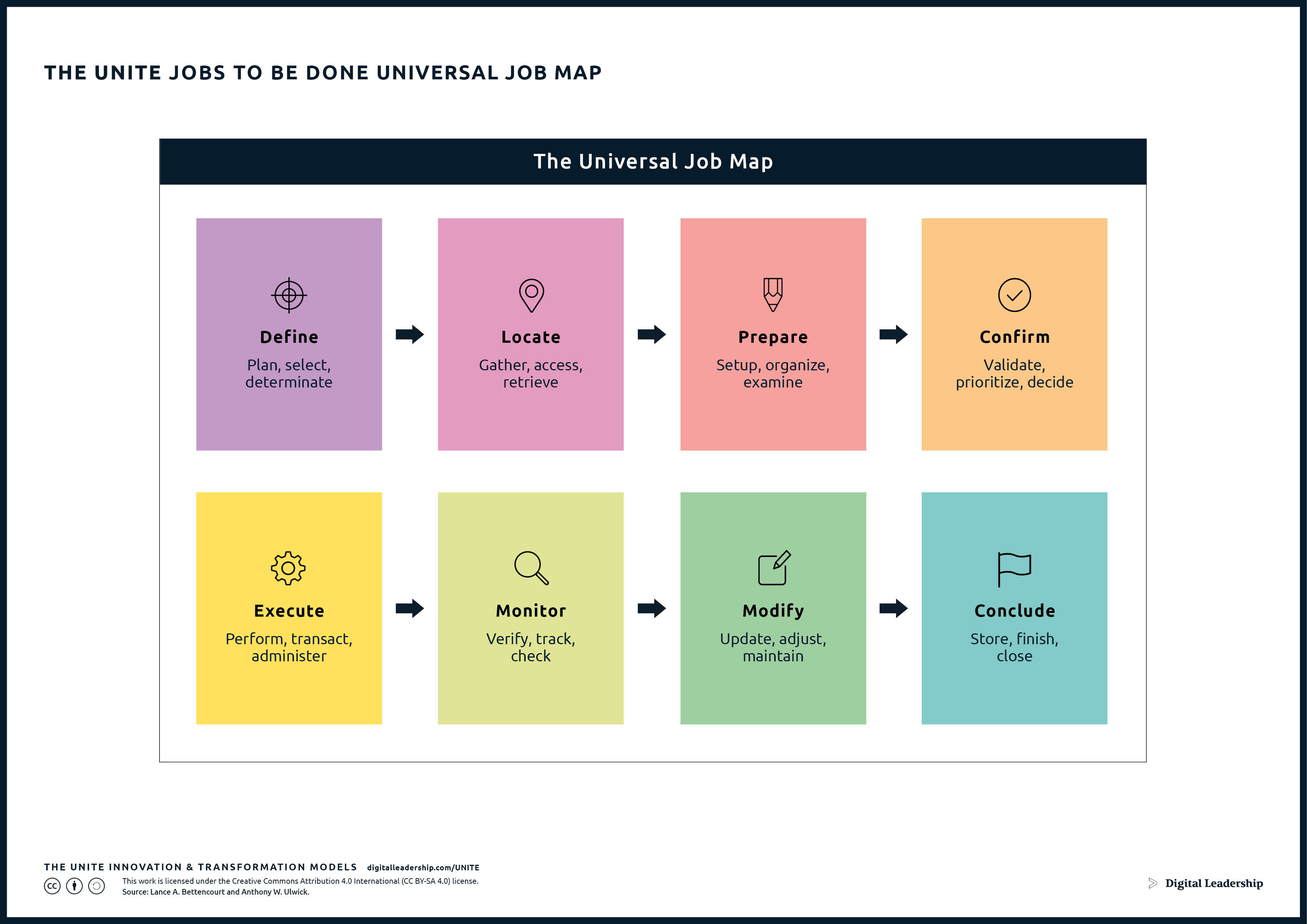
JTBD Universal Job Map. Credit: Digital Leadership, CC BY-SA 4.0, via Wikimedia Commons.
Running JTBD interviews: the step-by-step method
Step 1: Identify users to interview (1 to 2 days)
The best candidates for a JTBD interview are people who recently made a decision related to your product or service. The keyword is “recently”: memory fades fast, and contextual details are essential.
Target three profiles:
- New users who just adopted your product. Why did they “hire” your product? What job were they trying to accomplish?
- Users who just left (churn). Why did they “fire” your product? What job did it stop accomplishing?
- Users who hesitated but ended up choosing your product (or a competitor). What forces pushed them toward the change?
Recruit 8 to 12 people. For recruitment best practices, see the recruitment section of the article on user testing.
Step 2: Prepare the interview guide using the Switch Interview technique (1 to 2 hours)
The Switch Interview technique, developed by Bob Moesta and Chris Spiek (of the Re-Wired Group), is the go-to interviewing method for JTBD. It focuses on the precise moment when the user “switches” from an old solution to a new one.
The interview follows a timeline: you walk back in time with the user to reconstruct the decision journey, from the first thought (“maybe I should change solution”) all the way to adopting the new product.
Here are the main phases of the interview and the typical questions:
Phase 1: The first thought (10 minutes)
The goal is to understand what triggered the search for a new solution.
- “Can you tell me about the first time you thought about looking for a solution for [the job]?”
- “What was going on in your life at that point?”
- “What was bothering you about the way you were doing things until then?”
- “Was there a specific triggering event?”
Phase 2: Passive search (10 minutes)
After the first thought, there’s often a phase where the person starts looking at alternatives without really committing.
- “What did you do next? Did you start looking for alternatives?”
- “How did you search? (Google, a friend’s recommendation, an article, an ad)”
- “What alternatives did you consider?”
- “What made you hesitate to switch?”
Phase 3: Active search and decision (15 minutes)
The moment when the person actively compares solutions and makes their choice.
- “At what point did you decide to actually switch?”
- “Which criteria mattered to you?”
- “What tipped the scales in favor of [the chosen solution]?”
- “What worried you most about switching?”
- “Was there anything holding you back with your old solution?”
Phase 4: The post-purchase experience (10 minutes)
How the user lives with the new solution.
- “Does the solution meet your expectations?”
- “Are there things you miss from the way you used to do things?”
- “Would you recommend this solution? Why?”
The four forces of JTBD
During the interview, you’ll identify four forces that act on the user’s decision. This model is central to the Switch Interview method.
Two forces push toward change:
- Push: dissatisfaction with the current situation. “My current tool is too slow, I lose time every day.”
- Pull: the appeal of the new solution. “I saw a demo of this tool and it solves exactly my problem.”
Two forces hold back change:
- Anxiety of the new: fear of the unknown. “What if the new tool is even worse? What if I lose my data?”
- Habit of the existing: the comfort of what’s familiar. “I spent 3 years setting up my current tool, I know all the shortcuts.”
For change to happen, the push and pull forces have to outweigh the anxiety and habit forces. This model is extremely useful for understanding why some users adopt your product and others don’t.
Step 3: Run the interviews (45 to 60 minutes per interview)
A few practical tips for JTBD interviews:
- Anchor in the concrete. If the user says “I wanted something simpler,” ask: “Can you give me a concrete example of what wasn’t simple?” Generalities aren’t actionable. See the article on exploratory interviews to learn the follow-up techniques.
- Follow the timeline. Walk back in time, step by step. “And before that, what happened?” The goal is to reconstruct the full journey.
- Look for emotions. Emotional words (“frustrated,” “relieved,” “anxious,” “excited”) are strong signals. When you hear one, dig.
- Note the alternatives considered. When the user mentions a competitor or an alternative solution, ask what made the difference. That reveals the real decision criteria.
Step 4: Analyze the interviews and formulate the jobs (2 to 4 hours)
After your 8 to 12 interviews, gather your notes and proceed as follows:
-
Identify the recurring triggering situations. Which contexts come back across multiple interviews? These situations are your “When.”
-
Identify the common motivations. Beyond individual differences, which goals do your users share? These motivations are your “I want to.”
-
Identify the desired outcomes. What are they hoping to obtain in the end? These benefits are your “So that.”
-
Formulate the jobs. For each recurring situation/motivation/outcome combination, write up a job in the standard format. Aim for 5 to 10 main jobs.
-
Classify the jobs by dimension. For each identified job, spell out the functional, emotional, and social components.
-
Identify the four forces. For each job, document the push, pull, anxiety, and habit forces. That gives you concrete levers for your product strategy.
Tony Ulwick’s Outcome-Driven Innovation
Tony Ulwick, founder of the firm Strategyn, developed a complementary approach called Outcome-Driven Innovation (ODI). While Christensen focuses on qualitative understanding of jobs, Ulwick proposes a method to quantitatively measure which jobs are best and worst served.
The principle
For each job, Ulwick identifies the outcomes (desired results): the success criteria the user uses to evaluate whether the job is well done. For example, for the job “organize my tasks for the week,” the outcomes might be:
- Minimize the time spent planning my week.
- Minimize the risk of forgetting an important task.
- Maximize visibility on my priorities of the day.
Measuring the opportunity
For each outcome, Ulwick asks users two questions on a scale of 1 to 5:
- Importance: “How important is this criterion to you?”
- Satisfaction: “How satisfied are you with how your current solution addresses this criterion?”
The opportunity score is calculated as: Opportunity = Importance + max(Importance − Satisfaction, 0)
An outcome with high importance and low satisfaction represents a major innovation opportunity. That’s the “poorly served job” where you should focus your efforts.
When to use ODI?
ODI is particularly useful once you’ve already identified the main jobs and need to prioritize. It requires a quantitative sample (100+ respondents) and is generally run via an online survey. It’s a powerful complement to qualitative interviews.
JTBD vs personas: complementary, not competing
A question that comes up often: “Should I use JTBD or personas?” The answer is: both, because they answer different questions.
What personas bring
Personas describe who your users are. They document the demographic characteristics, behaviors, attitudes, and frustrations of a user segment. They help the team build empathy and keep the user in mind during design decisions.
What JTBD brings
JTBD describes why your users act. It focuses on motivations, circumstances, and desired outcomes, regardless of the user’s demographic profile.
In practice
Use personas to segment your users and build empathy. Use JTBD to understand deeper motivations and identify innovation opportunities. Cross the two: which jobs are specific to a persona? Which jobs cut across personas?
For example, if you have two personas (“Sarah, 35, manager at a mid-sized company” and “James, 52, director at a large corporation”), it’s possible they share the same job: “When I’m preparing for an important meeting, I want to quickly access the key numbers, so that I don’t lose credibility in front of my audience.” The job is the same, but the solution may vary by persona (Sarah uses a dashboard, James prefers a PDF report).
Common mistakes to avoid
1. Confusing the job with the solution. “I want to use a to-do list app” isn’t a job. It’s a solution. The job is: “I want to keep track of everything I have to do so that I don’t forget anything.” If you frame the job in terms of a solution, you box yourself into one product and miss the alternatives.
2. Formulating jobs that are too vague. “I want to be happy” isn’t an actionable job. A good job is specific, tied to a concrete situation and a measurable outcome. If your job could apply to anyone in any situation, it’s too vague.
3. Neglecting the context. The “When” is often the most important part of the JTBD formula. The same need in two different contexts is two different jobs. “When I’m in a hurry in the morning” and “When I take the time to cook on Sunday” are two situations that call for very different solutions, even if the underlying functional job (“feed myself”) is the same.
4. Stopping at the functional job. If you ignore the emotional and social dimensions, you’ll miss the real drivers of decision. People don’t buy a Tesla just to “get around in an electric car” (functional job). They also buy it to “feel ahead of their time” (emotional job) and “show that they’re environmentally conscious” (social job).
5. Running interviews with closed questions. JTBD interviews must be open and narrative. Avoid questions like “Is speed important to you?” Prefer: “Tell me about the last time you were frustrated by [your current solution].”
6. Skipping the four forces step. Identifying the job isn’t enough. You need to understand why people don’t act. If the anxiety and habit forces are too strong, even the best product won’t be adopted. Systematically document the four forces.
7. Ignoring “non-consumers.” People who don’t use any solution to get a job done are often the best sources of learning. They have the same job, but no existing solution satisfies them enough. Why? The answer can reveal a major innovation opportunity.
Going further
- Exploratory interviews: the questioning techniques that apply to JTBD interviews.
- The experience map: to chart the jobs within the broader user journey.
- Active listening: the indispensable mindset to run a JTBD interview.
- Christensen, C. (2016). Competing Against Luck: The Story of Innovation and Customer Choice. Harper Business. The foundational book on JTBD.
- Ulwick, T. (2016). Jobs to be Done: Theory to Practice. IDEA BITE PRESS. The reference for Outcome-Driven Innovation.
- Klement, A. (2018). When Coffee and Kale Compete. Available free online. A clear, practical introduction to JTBD.
Want to go further?
I offer individual coaching to dig deeper and apply these topics to your context.
Book a session