What is active listening?
What is active listening, in detail?
Active listening is a communication approach that uses open questioning and reformulation to fully understand someone’s message and to show them you’ve understood. It relies on postures and techniques designed to help the other person speak. While doing active listening, the interviewer accepts the other person as they are, here and now, without trying to change anything and without expecting anything in return.
Carl Rogers (1902 - 1985) is the father of the term “Active listening”. An American humanist psychologist, he was ranked the 6th most influential psychologist of the 20th century by the Review of General Psychology in 2002. He coined the term in 1957, in an article titled Active Listening. Together with Richard Farson, he laid out the value of person-centered listening.
Carl Rogers’ books and papers influenced many other psychologists, including Marshall Rosenberg, the father of Nonviolent Communication, and more broadly all the psychologists in the humanist tradition.
For Carl Rogers, the emotions tied to a situation matter more than the situation itself. When the conversation is about a specific problem, what matters is to understand how the other person perceives the problem rather than the problem itself. Doing this requires a specific posture to help the other person express themselves. Those are the foundations of the so-called Rogerian approach.
An example of active listening in action
Here’s a high-level example of active listening from Quebec paramedics in a serious situation. Heads up, the video is fairly hard to watch: you can see two different paramedics demonstrate active listening with someone whose loved one has just passed away.
Example video of active listening in a difficult case (death) (in French)The 3 fundamental attitudes of the Rogerian approach
The 3 fundamental attitudes Carl Rogers describes in his person-centered approach are:
- empathy
- congruence
- unconditional positive regard
Empathy
Empathy is an attitude where you make a conscious effort to understand the other person’s emotions and feelings.
It means making the effort to understand how the other person experiences the situation, in order to be able to do the mental work of “putting yourself in their shoes”. It’s essential to do these two steps in this order: you can’t put yourself in someone’s shoes if you haven’t first tried to understand the emotions they feel at that exact moment, otherwise you risk interpreting through your own filters.
In empathy, keeping a degree of emotional distance is an important component, because the point isn’t to share the other person’s emotions: that would be sympathy. Sympathy adds an affective layer where you try to support the other person, especially in a tough situation. That’s not what we’re after in active listening: we focus on the other person here and now without trying to change anything.

Congruence
Congruence is an attitude that means being perfectly consistent between what you feel, what you think, what you do and what you say. In other words, it’s the alignment between who you are, what you do and what you say. It’s also called authenticity.
Congruence touches on your values: what actions are you taking to honor and defend those values? For context, congruence affects your credibility, especially during public speaking. Strong congruence is generally associated with a strong reputation.
In the Rogerian approach, the interviewer must model congruence (and therefore authenticity) to show the other person that they too are a real human being and not an expert or a junior psychologist. So it’s essential to be yourself (and to make the techniques your own in your own way) during active listening, because without that, no matter the techniques, it’ll ring false and the other person won’t fully open up.
Active listening requires you “to take off your masks”, which means doing personal work is an important step in being effective with this approach.

Unconditional positive regard
Unconditional positive regard is an attitude that means being warm, positive and receptive toward the other person. It’s a complete absence of evaluation, where we let go of judging the other person.
The point is to accept the other person in their entirety (accepting both their positive and negative feelings), as they are, without trying to help or change anything. For Rogers, “accepting means opening yourself to everything your client may feel in the moment”. In the intimacy of a conversation, it’s possible to feel positive consideration for someone who has hit another person if they’re talking about their remorse, even if the act itself is wrong.
Another concept that fits inside this attitude is the “life positions” model (from transactional analysis). The diagram below lays out the different positions: it shows the path to walk in order to have a healthy interaction.
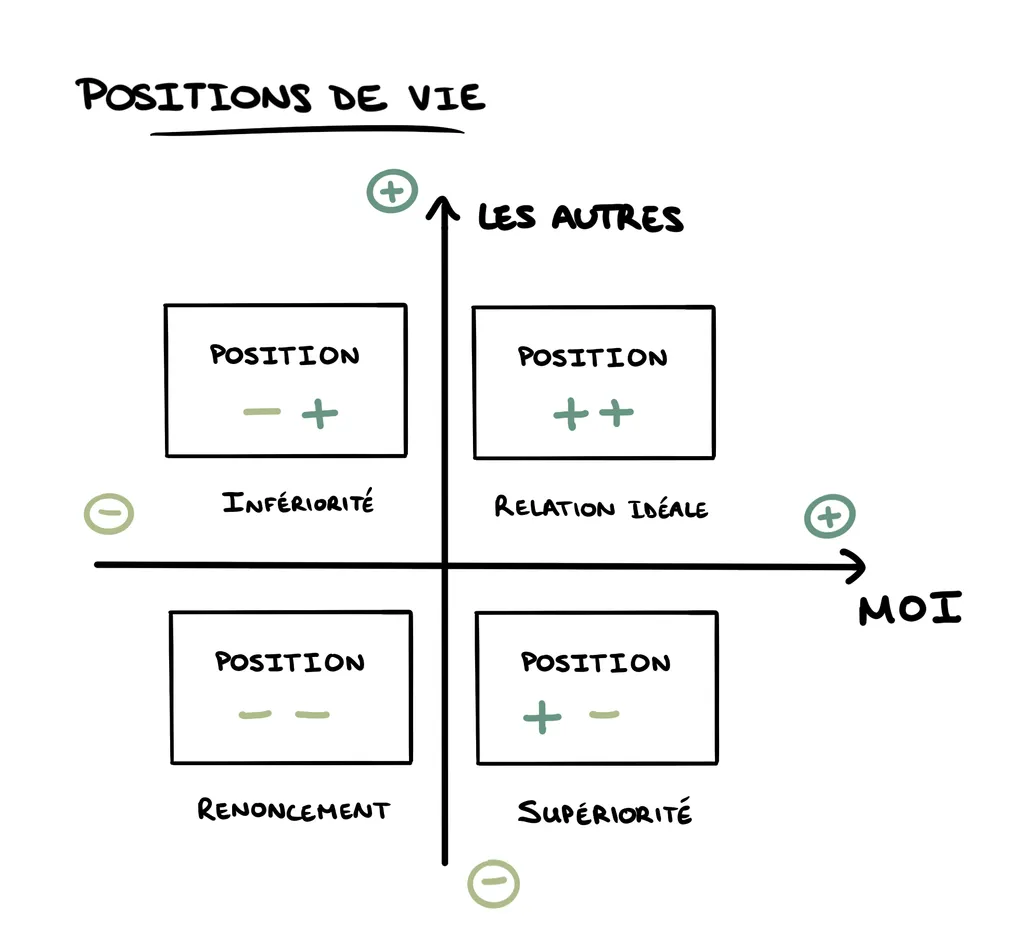
- The healthiest position for active listening is the ideal relationship (I’m OK / the other is OK).
- The inferior position (I’m not OK / the other is OK) reduces our congruence and makes it harder to build trust between the two people.
- The superior position (I’m OK / the other is not OK) reduces our capacity for empathy because that attitude leads to contempt and judgment, which makes it harder for the other person to open up.
- The giving-up position (I’m not OK / the other is not OK) generally won’t allow you to step into an active listening posture.
It’s of course hard to always stay in this attitude of unconditional positive regard, but you can strengthen it through practice. That said, sometimes we simply can’t access that openness, because it depends on the person across from us. In those cases, it’s better to switch interlocutors (either the interviewer or the interviewee).
The 3 phases of active listening
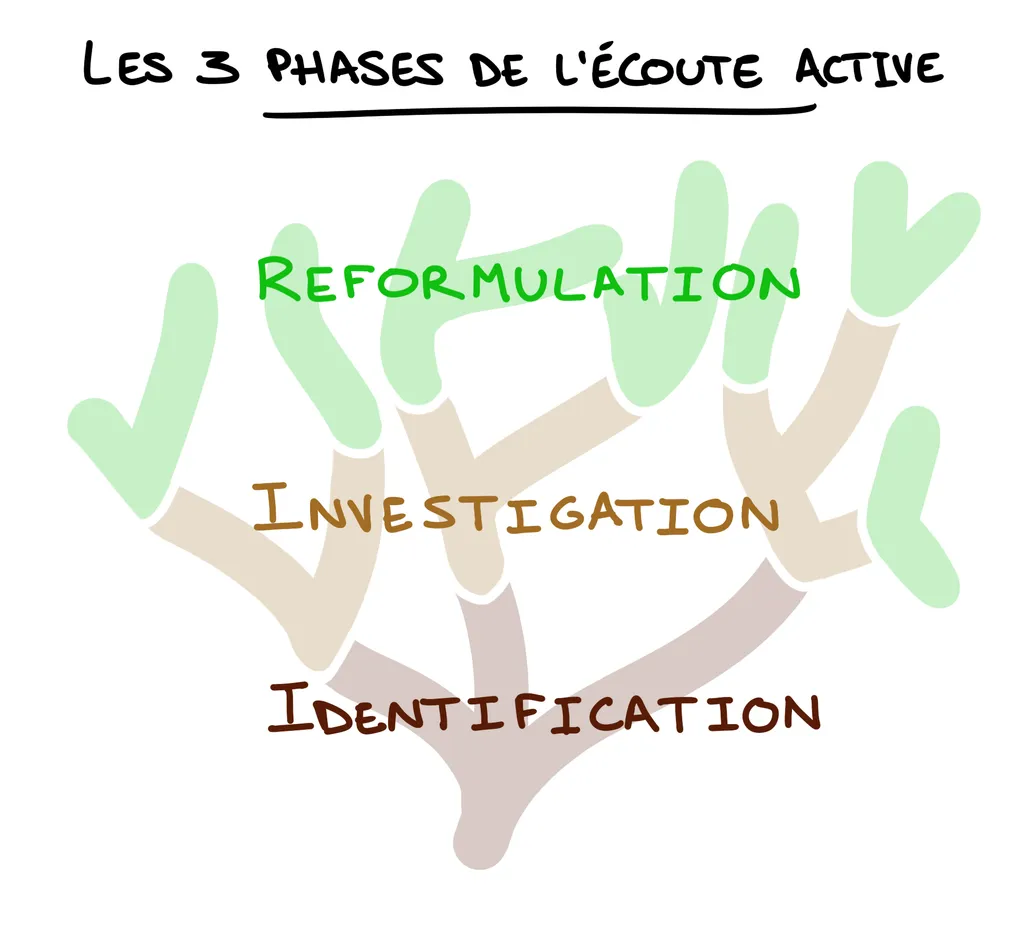
During an active listening session, the interviewer stays quiet and listens 95% of the time. Their goal is to set up enough trust to have an authentic conversation. This isn’t a consultation. To pull this off, the following 3-phase cyclical process works well:
- Identification
- Investigation
- Reformulation
Identification
In a conversation, the goal is to focus on the salient elements of the experience being shared. You’re looking for the building blocks that will structure the interview. Picture, for example, the different topics that come up in response to “What does ecology evoke for you?”. Each “big idea, big theme” that emerges is a topic to identify.
These are:
- The key ideas the interviewee puts forward
- Their feelings about a situation
- Their points of view
Each of those topics will need to be addressed and investigated.
Tip: when you take notes during the interview, always jot down the identified themes in a notebook so you don’t forget them. Once you’ve investigated another topic, you can come back to them more calmly. Do this even if there’s another note-taker.
Investigation
Investigation comes in 3 flavors. You investigate to:
- Clarify something you didn’t understand. e.g. “Could you walk me through that point again, please?”
- Dig into a point to go deeper. e.g. “Could you give me an example of what you’re describing?” or “The last time this happened, what went on?”
- Dig into an emotion. e.g. “I get the sense this situation worried you a lot…”
The whole point here is to get the person talking, so they end up expressing the emotions tied to a situation.
The second goal is to get as close as possible to a perfect understanding of the situation the other person described, with no interpretation. Don’t hesitate to dig into the person’s reasoning even if the answers seem obvious; you might be surprised.
Reformulation
Reformulation is a technique that aims to give the other person back a synthesis of what they told you. It usually means repeating word for word what the other person just explained.
Reformulation is the only proof of listening. It assures the other person they’ve been heard.
Reformulation lets the other person feel understood and gives them the chance to adjust their statement, correct course or add nuance after a reformulation. It can also help the other person take a step back from what they’re saying or going through.
A full example of the active listening process: breakfast
Here’s a sample conversation to illustrate the identification - investigation - reformulation cycle:
- Interviewer: “Can you walk me through your last breakfast?”
- Interviewee: “I had toast with butter and jam, and a coffee.”
- Interviewer (reformulation): “Got it, so you had butter-and-jam toast and a coffee.”
- Interviewee: “Yes, that’s right.”
- Interviewer (investigation - dig): “And the last time you had this breakfast, how did it go?”
- Interviewee: “Honestly, I was in a rush, I barely had time to eat.”
- Interviewer (investigation - emotion): “It sounds like that frustrated you a bit…”
- Interviewee: “Yes, that’s true. I would have liked to take more time for myself in the morning.”
- Interviewer (reformulation): “So if I’m hearing you right, you’d like to have more time in the morning to enjoy your breakfast at a calm pace.”
Active listening techniques
Basic active listening techniques
- Reformulate: synthesize what the other person said by repeating what they just told you
- Ask for concrete examples: dig with a question like “the last time you did this, what happened?”
- Bounce off the most recent point: keep asking about the last thing the person mentioned
Advanced active listening techniques
- Phrase your investigation questions in the past tense: say “what did you do during your shopping” rather than “what do you do during your shopping” so you get details on a real past experience instead of something reconstructed on the fly
- Respect silences: don’t speak when the person is still thinking, don’t rush to ask your next question (don’t be afraid of silence!)
- Know a list of key questions by heart to bounce off of, available here: Asking the right questions
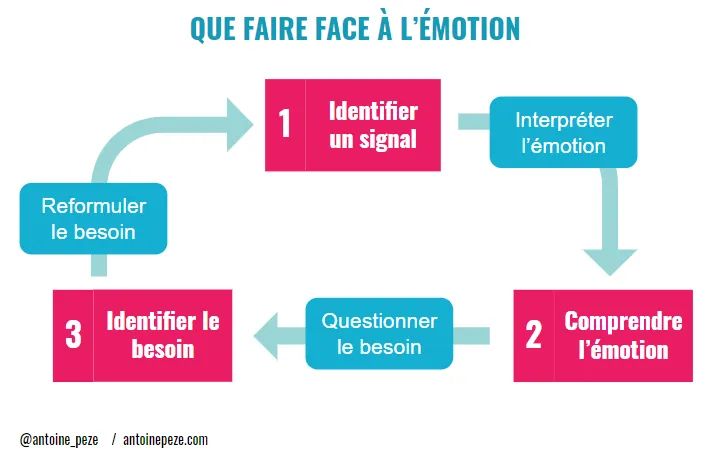
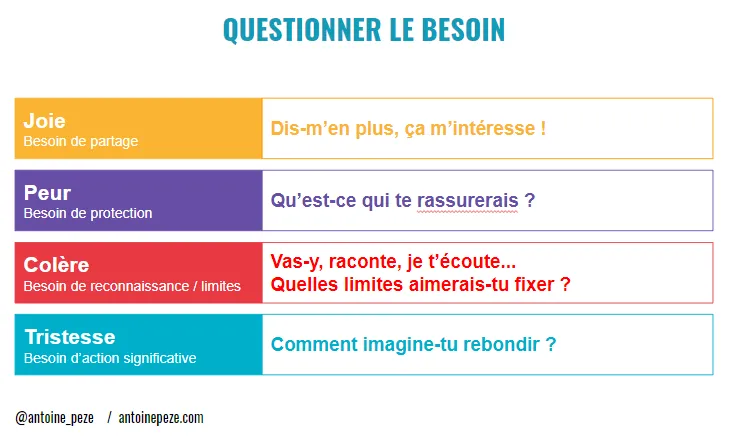
- Interpret emotions: name emotions when you detect them, dig into the underlying need, then reformulate
The postures of active listening
Basic active listening postures
- Don’t interrupt: every time, let the other person finish what they’re saying
- Align your body: make eye contact and align your feet and nose with the other person
- Support the speaker: give a few nods, “mhm”s, quiet “OK”s or any other cue that shows you’re focused on what they’re saying
Advanced active listening postures
- Respect what’s said even when you disagree: don’t react if something hits your values, understanding doesn’t mean accepting!
- Reveal your feelings: smile during a happy story, wince during a heavy moment, in short, support the other person’s words through your nonverbal cues
- Resist your impulsivity: don’t reply even if the other person asks you to, don’t give an opinion or advice
- Control your distracting gestures: watch your nonverbal cues, which often reveal your judgment
Conclusion
Active listening is a communication approach that uses open questioning and reformulation to fully understand someone’s message and to show them you’ve understood.
It builds a trust-based relationship during the conversation that pushes the other person to open up.
It rests on:
- 3 fundamental attitudes: empathy, congruence, unconditional positive regard
- 1 process: identification, investigation, reformulation
- postures: don’t interrupt, respect what’s said, don’t show your judgment
- techniques: bounce, ask for concrete examples, ask in the past tense, probe emotions, reformulate
Going further
Sources
- ACTIVE LISTENING by Carl R. Rogers and Richard E. Farson (1957): http://wholebeinginstitute.com/wp-content/uploads/Rogers_Farson_Active-Listening.pdf
- Learn more about unconditional positive regard: https://www.cairn.info/revue-approche-centree-sur-la-personne-2013-1-page-65.htm (in French)
Want to go further?
I offer individual coaching to dig deeper and apply these topics to your context.
Book a session