How to give great feedback
TL;DR
Summary
The act of sharing a response with someone about a behavior they had.
Goal
Encourage effective future behaviors.
Definition
According to the Oxford dictionary, feedback is advice, criticism, or information about how good or useful something or someone’s work is.
On his blog Bloculus, Maxence Walbrou defines feedback as follows.
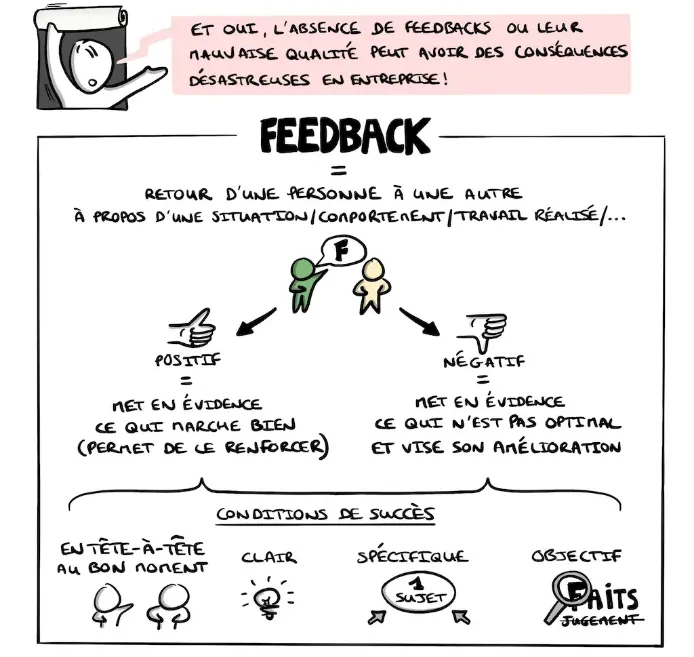
Image by Maxence Walbrou, available at this link: https://bloculus.com/sauvez-des-vies-faites-des-feedbacks/ (in French)
Why give feedback

From the book The Effective Manager, by Mark Horstman
The whole point of feedback is to focus on the future, not the past. That’s why the minus sign doesn’t appear in the future side of the diagram above.
If you think someone made a mistake, you want a different behavior. If you think someone succeeded, you want more of the same behavior.
How to give feedback
Ask whether the person is available
For the request, it’s essential that the person is open to feedback. So you’ll ask them if it’s a good time. And if it isn’t, ask later (but that’s really rare).
A few example phrasings:
- “Can I give you some feedback?”
- “May I share an observation?”
- “Can I share something with you?”
The different types of feedback
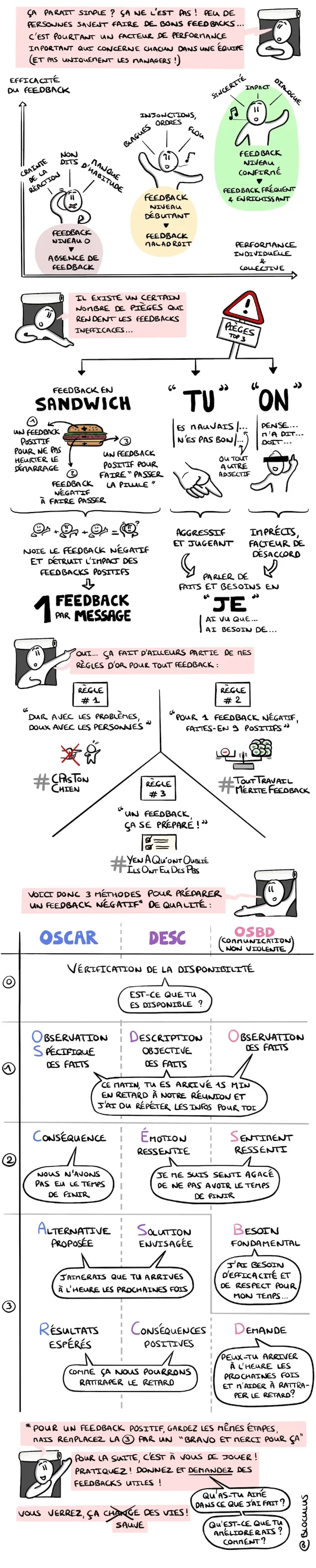
Image by Maxence Walbrou, available at this link: https://bloculus.com/sauvez-des-vies-faites-des-feedbacks/ (in French)
A mnemonic for stating the facts
Describing precisely the behavior that occurred is essential for any feedback. You need to rely on facts, not feelings. The whole point is to put the situation back in context with precise facts, so the person on the receiving end has a clear memory of what they did.
A simple way to start your feedback is:
- When you … (insert the behavior)
This forces you to focus on what the other person did, in a descriptive way.
A few counter-examples:
- “When you had that bad attitude earlier…” => this isn’t a factual description, it pushes the other person into a defensive posture because there’s a judgment “When you nailed it earlier” => this isn’t precise enough, it doesn’t let the other person know what was specifically positive
- Better to go with something like: “When you stayed perfectly calm after the client insulted you…” “When you didn’t keep your commitments…” => this isn’t precise enough, it won’t let the other person quickly recall the right context
- Better to go with something like: “When you promised me that document yesterday and didn’t deliver it…”
Favor positive feedback
We tend to think feedback is just for “calling people out”, but that’s wrong. It’s essential to give plenty of positive feedback to the people around you when something stood out positively.
Even if it surprises people the first time you do it, the more you repeat it, the more natural it becomes.
Example 1
- Manager: “Can I give you some feedback?”
- Report: “Sure”
- Manager: “When you volunteered to give the new hire the office tour, it let me wrap up my tasks because I had something urgent. Thanks.”
Example 2
- Colleague 1: “Can I share a response with you?”
- Colleague 2: “Go ahead”
- Colleague 1: “When you stayed perfectly calm with that client who was insulting you, the client called me back afterwards to thank me. Well done.”
If you don’t have alternatives or solutions to suggest
Here are a few key phrases to handle that. It’s obviously better to prepare your feedback and have a solution direction in mind.
- “Can you change that?”
- “Can you work on that?”
- “How could you do that differently?”
This way you can have very quick feedback like:
- Colleague 1: “Can I share something with you?”
- Colleague 2: “Yep”
- Colleague 1: “When you promised me the data yesterday but didn’t send it, I struggled to prep my presentation for tomorrow. Can you work on that please?”
- Colleague 2: “OK, I’m on it.”
When to give feedback
Don’t wait to give feedback. Not saying things or avoiding them is the worst thing for an organization.
That said, immediacy isn’t required. Do it as soon as possible. If it’s 30 seconds later, that works. Same if it’s 3 or 4 days later.
However, be careful with feedback on situations more than a week old (from the book The Effective Manager). The more time passes, the more the value of the feedback declines. The person doesn’t remember well, which makes it hard to drive toward more effective behavior if they don’t know what to change.
And above all, if you’re angry, don’t give feedback. Really.
Wait a bit, breathe. Once it’s passed and you’ve regained your calm, the moment is more appropriate. But be wary of those moments, you could regret it deeply.
What to do after giving feedback
I’d strongly suggest moving into an active listening posture. To sum up, listen without justifying yourself or looking for excuses, and rephrase!
Once you’ve really got how the other person is making sense of the situation, you can take a position. But clearly separate “listening” mode from “my point of view” mode. Because yes, the goal is to start a discussion and for you to be able to share your point of view.
Last step, make sure to introduce a solution to close out the feedback point. If you don’t have a solution in mind, offer to come back to the person after some thinking, as quickly as possible.
Giving feedback in writing
Giving feedback in writing has the advantage of giving you plenty of time to think and find the right words. If you want to give written feedback, follow the same steps:
- Ask whether the person is available: “I’d like to give you feedback on the work we did together, would you be OK with me sending it in writing?”, “Cool, go ahead! Want me to do one for you too?”
- Use precise facts
- “you’re reliable, especially that time when… and I liked it because…” rather than “you’re reliable and I liked it because” Think about the emotions, needs, and/or consequences behind it, which need to be tied to a precise fact. Suggest improvement directions where relevant
An effective template for written feedback
Here’s the approach I’d suggest, very simple and especially effective for giving feedback on someone or even on a project (you’ll need to name the people involved, no fuzziness, no beating around the bush!):
What I liked about you:
- point 1 (precise fact, emotion / consequence)
- point 2
- etc.
Areas for improvement I see:
- point 1 (precise fact, emotion / consequence, improvement direction)
- point 2
- etc.
Going further
- Active listening: the posture to adopt after giving feedback
- Understanding emotions: to identify feelings before giving feedback
- Handling conflict: when feedback reveals a deeper disagreement
Sources
THE EFFECTIVE MANAGER by Mark Horstman (2016): http://wholebeinginstitute.com/wp-content/uploads/Rogers_Farson_Active-Listening.pdf
Bloculus blog, by Maxence Walbrou: https://bloculus.com/ (in French)
Want to go further?
I offer individual coaching to dig deeper and apply these topics to your context.
Book a session