How to handle a conflict
TL;DR
Summary
Use emotions to understand the other person and express your needs to find the best possible solution.
Goals
Become more assertive to better handle conflict situations.
Introduction
Even though conflict often gets a bad rap, it’s deeply constructive for a group or a society. Conflict is constructive in the sense that it lets the group address a clash of interests and do something with it: in fact, both parties can come out of it as winners under certain conditions.
So how do you go about a conflict? Which levers do you need to pull to defuse a situation? What posture should you adopt? That’s what we’ll dig into here.
What is a conflict?
A conflict, or conflict situation, is a state of opposition between people or entities. It often happens when one of the parties tries to assert their position without taking the others’ positions into account. But simply disagreeing on ideas isn’t what defines a conflict.
When we talk about conflict, we can identify several types of situations:
- Intra-personal conflicts, or internal conflicts
- Inter-personal conflicts, or conflicts between people. We’ll only be talking about these types of conflicts
- Intra-group conflicts, or conflicts between several people facing others within the same group
- Inter-group conflicts, or conflicts between groups or communities with different cultures or ideologies
The strategies tied to a conflict situation
-
Avoidance or flight
-
Both parties get frustrated: nothing gets resolved
-
Accommodation
-
You want to ease tensions at all costs, you avoid confrontation and decide to give in to whatever the other person wants without listening to your own needs.
-
Satisfaction for the other, frustration for you
-
Rivalry
-
This is choosing an authoritarian stance, with a complete lack of cooperation and listening. You don’t look for a solution that could leave everyone better off.
-
Satisfaction for you, frustration for the other
-
Compromise
-
This is “give-and-take” negotiation. It’s an acceptable solution in many conflicts, but it doesn’t always resolve the situation deeply.
-
Partial satisfaction for both parties
-
Requires a certain maturity from both parties
-
Collaboration
-
You aim to fully understand the other person’s needs and then share yours to find a solution that works for everyone. Agreeing to open up enables greater understanding and more creative solutions.
-
Satisfaction for both parties
-
Requires a certain maturity from both parties
Emotion and conflict
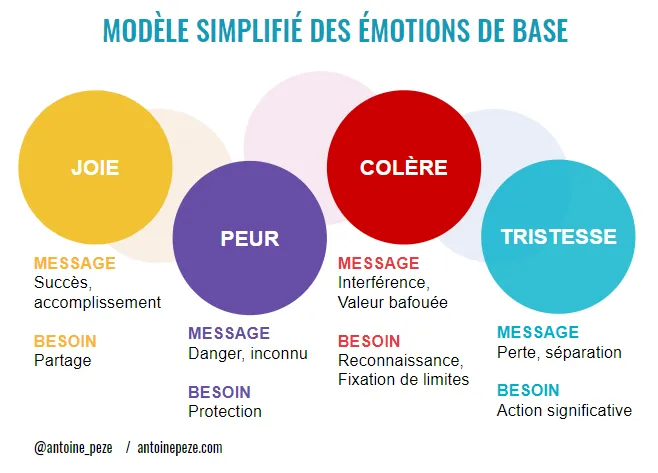
Conflicts rooted in anger
In the simplified basic emotions model, anger carries 2 messages:
- On one side there’s interference, which can lead to misunderstandings. Something disrupts us, like language clashes or a difference in interpretation.
- On the other there’s a violated value, which can lead to conflicts around values. We don’t see things the same way, and something trivial to one person may be deeply important to another.
- This type of conflict is generally resolved by listening to the other person to try to identify the values, and most importantly, by setting boundaries. Even though it sounds unusual, being able to set boundaries lets you define the zone within which the other person feels respected. These are the hardest conflicts to handle, since it’s especially hard to shift on your values.
Conflicts rooted in fear
In the same model, fear carries the message of danger or the unknown:
- a new, still-unknown situation that could have impacts on your own interests can lead to conflicts around a divergence of interests. This effect is reinforced by the endowment effect described by Kahneman, which shows that loss aversion is stronger than the potential gain when you already own something.
- This type of conflict is generally resolved by listening to the other person about what would reassure them in this kind of situation. Once that information is known, a negotiation phase typically begins.
Defusing a conflict through emotions
Every conflict requires listening to the other person’s point of view. If you decide to address a conflict, it’s essential to commit to making that effort. Generally, adopting an active listening posture before staking out your position is particularly effective to start regulating a conflict.
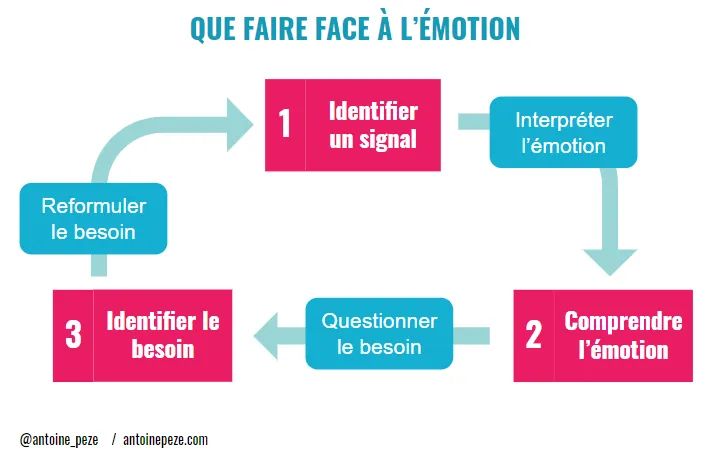
When you’re trying to resolve a conflict, remember the following model, drawn from Nonviolent Communication. In any speech, there are 3 domains to spot:
- thoughts
- emotions
- needs
If you want to defuse a conflict, 3 tips:
- Don’t stay in the realm of thoughts! Thought versus opposing thought never moves things forward. The solution is to drop down a level!
- Defuse by acknowledging the other person’s emotion. It’s one of the most effective ways to de-escalate a situation, which then lets you understand the needs.
- Reformulate the need once it’s identified. Knowing this is what makes a conflict useful and a win for everyone.
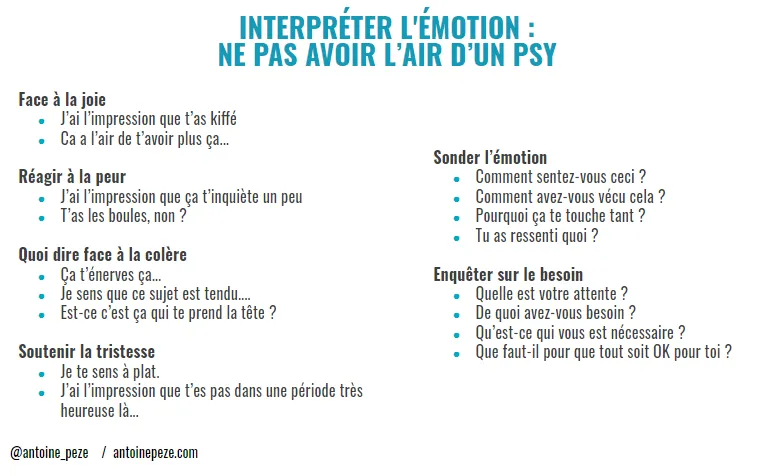
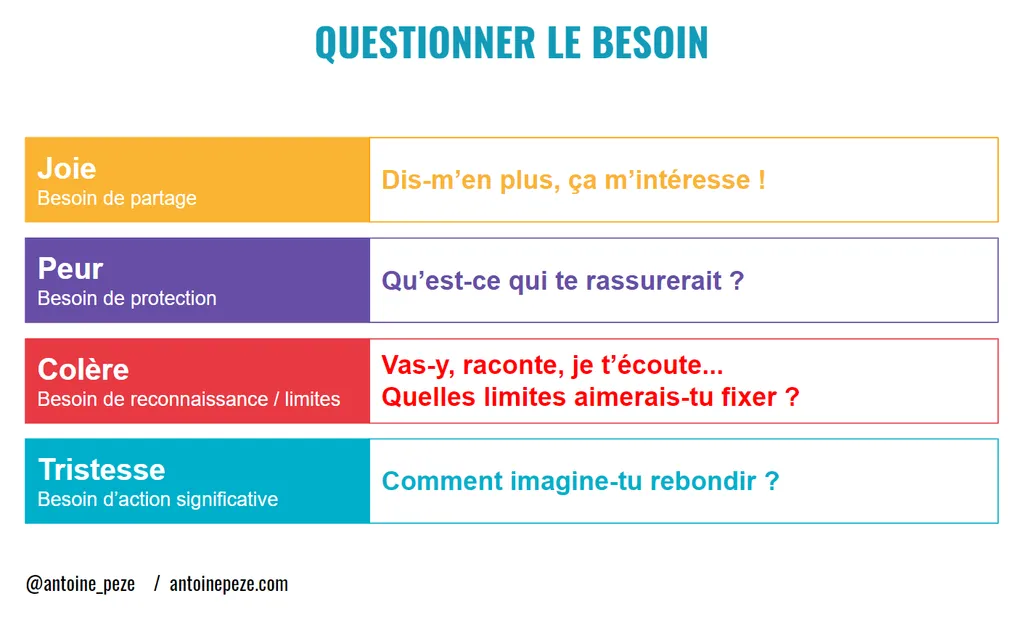
To help you in this approach, here are a few diagrams that illustrate the situation:
- the full cycle to deeply understand a need in someone else
- a guide of questions and phrases to interpret the other person’s emotion while keeping a climate of trust (because nobody likes being analyzed without asking for it)
- a guide of questions to find the dominant underlying need
Positioning yourself in a conflict: assertiveness
Assertiveness is the ability to assert your position while keeping positive relationships with others. It’s standing up for yourself while still respecting the other person.
The 3 values of assertiveness:
- Self-respect: toward integrity
- Respect for the other person’s way of seeing things: toward maturity
- Relationships not based on violence or deception/concealment
So assertiveness is a posture that first aims to fully understand the other person before trying to express yourself frankly, in a healthy and constructive attitude. We clearly separate the active listening phase from the phase of expressing your needs. In the second phase, the goal is to be congruent, that is, to be yourself without trying to minimize or justify yourself.
This way, the conversation opens up and creates room to bounce around in search of the best possible solution. That’s how you move from compromise to collaboration to build healthy, lasting relationships.
A few examples of assertive vs non-assertive attitudes:
-
Assertive attitudes: standing up for yourself, managing your emotions, respecting the other person, being clear, being firm, being empathetic
-
Non-assertive attitudes: lying, getting angry, betraying, threatening, accusing, submitting, mocking, belittling, attacking
Assertiveness is a posture that you learn and cultivate. So train for it!
Thanks to Marc Boujnah for this definition of assertiveness!
Listening to your own needs before tackling a conflict
You’ll have understood that emotions play a particularly important role in conflicts. And as I explained at the start, conflicts usually drag on when there’s no listening, when one party isn’t trying to listen to the other. So it’s necessary to bring conflicts into the open to enable communication.
That said, to be able to address conflicts, you need to have enough energy (and willpower). It’s that much easier to be open to others’ needs when your own needs are met. This implies 3 things:
- Being aware of your own needs
- Knowing whether they’re met or not
- Identifying the strategies to meet them
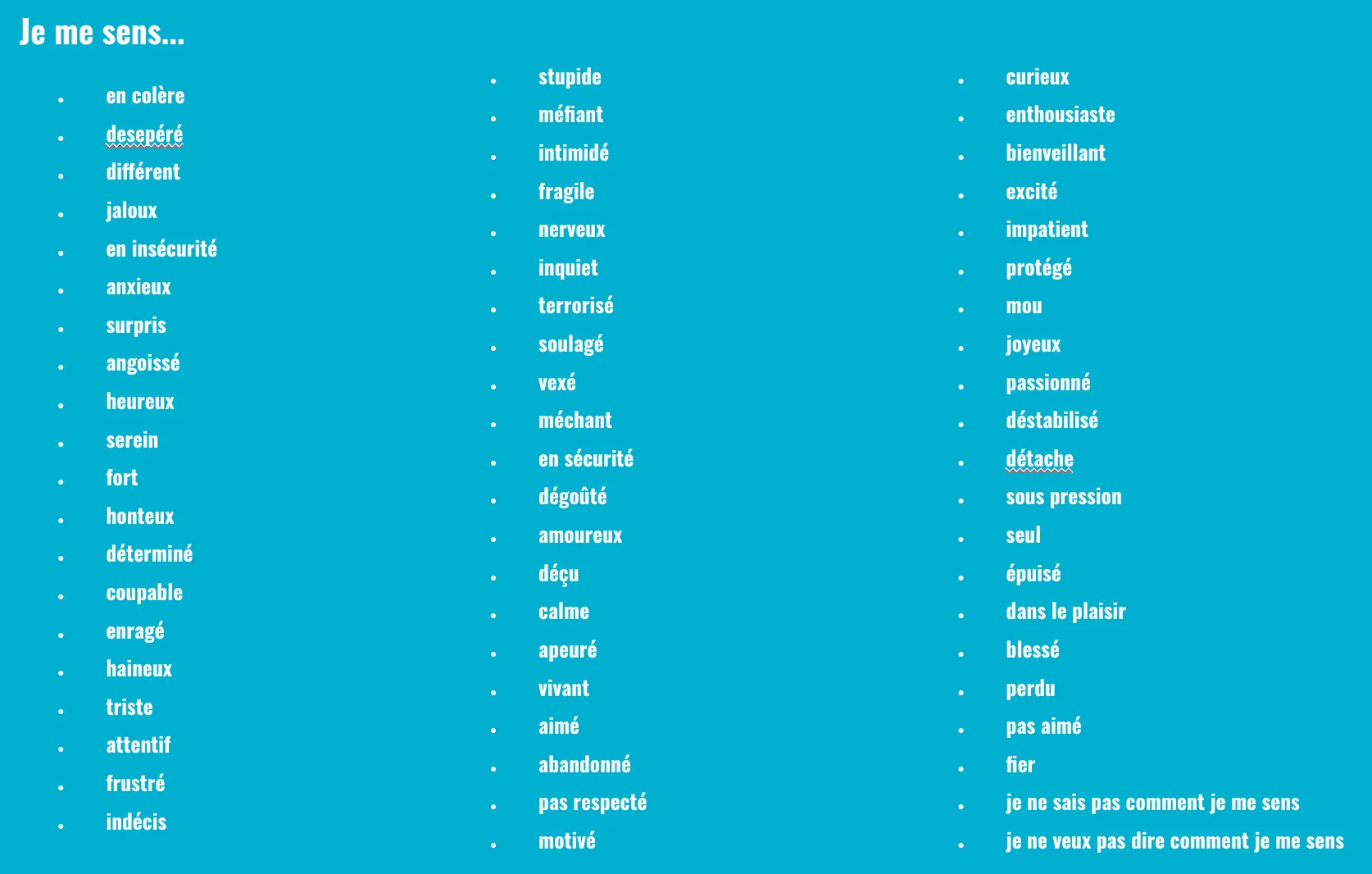
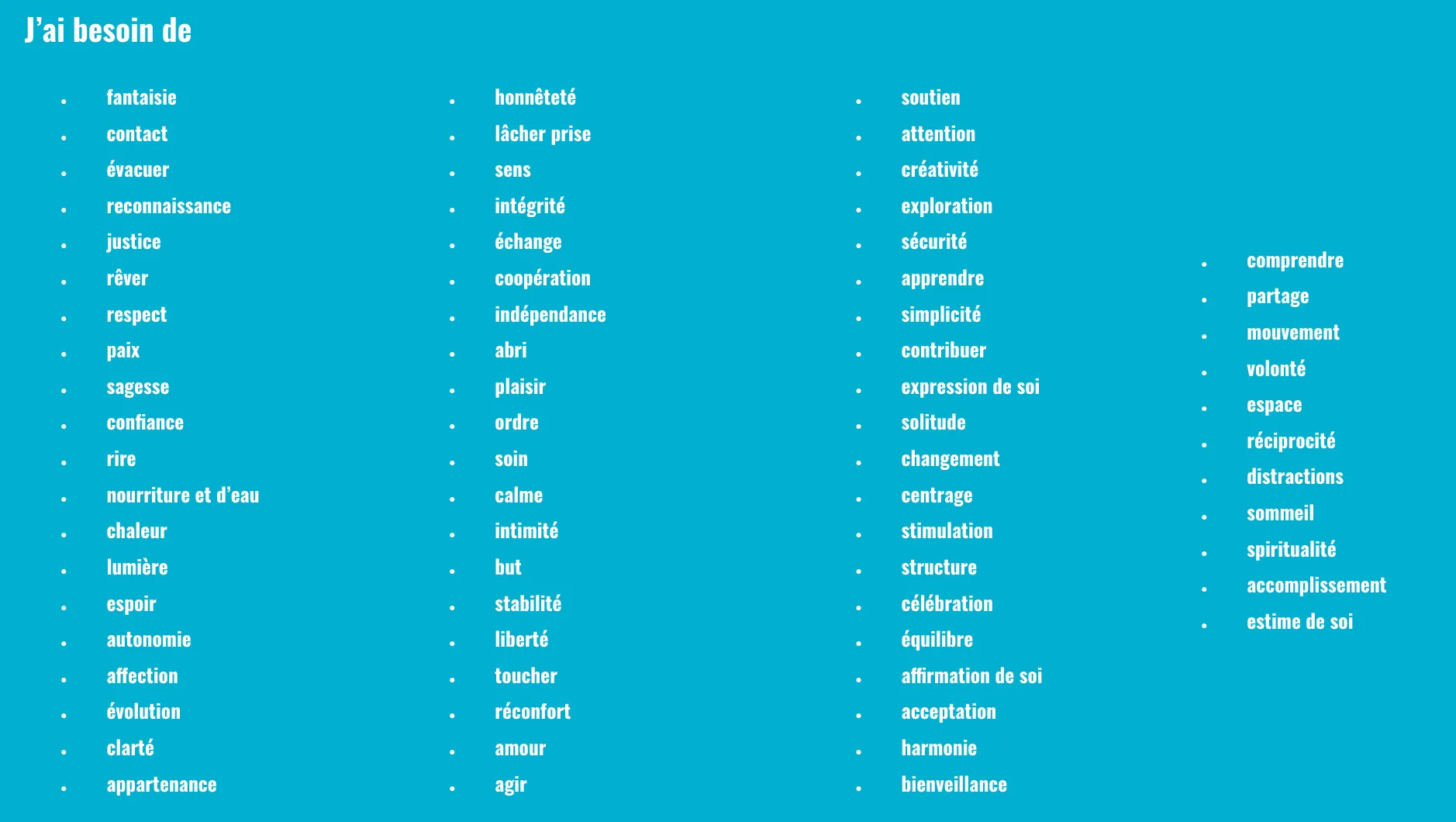
Facilitation exercise using NVC feelings and needs
A clever way to understand a conflict situation is to analyze it through the lens of feelings and needs from Nonviolent Communication. It’s a 4-step process:
- I think back to a conflict and identify the emotions that situation has already triggered in me.
- I then try to identify my counterpart’s emotions.
- I try to deduce my counterpart’s needs from there.
- Finally, I identify my own needs.
At the end of the exercise, I look at my needs to see whether they’re met and what strategies could meet them.
Once I have this information:
- I’m aware of my needs and I’m able to use them in my negotiation
- I can deal with my own needs first before tackling the conflict, so I have enough energy
- I better understand the other person’s situation and I’m capable of greater empathy
Going further
- Understanding emotions
- Understanding active listening
- How to give good feedback
- Buy the workshop cards describing emotions: “Le langage des émotions” (in French)
- Buy the workshop cards describing needs: “L’expression des besoins” (in French)
Sources
- Daniel Kahneman, Thinking, Fast and Slow, Farrar, Straus and Giroux, 2011: https://livre.fnac.com/a4067022/Daniel-Kahneman-Thinking-fast-and-slow
Want to go further?
I offer individual coaching to dig deeper and apply these topics to your context.
Book a session